Opens the first reel: "Sai-Gon + Bien Hoa." Handwritten, blue ground.
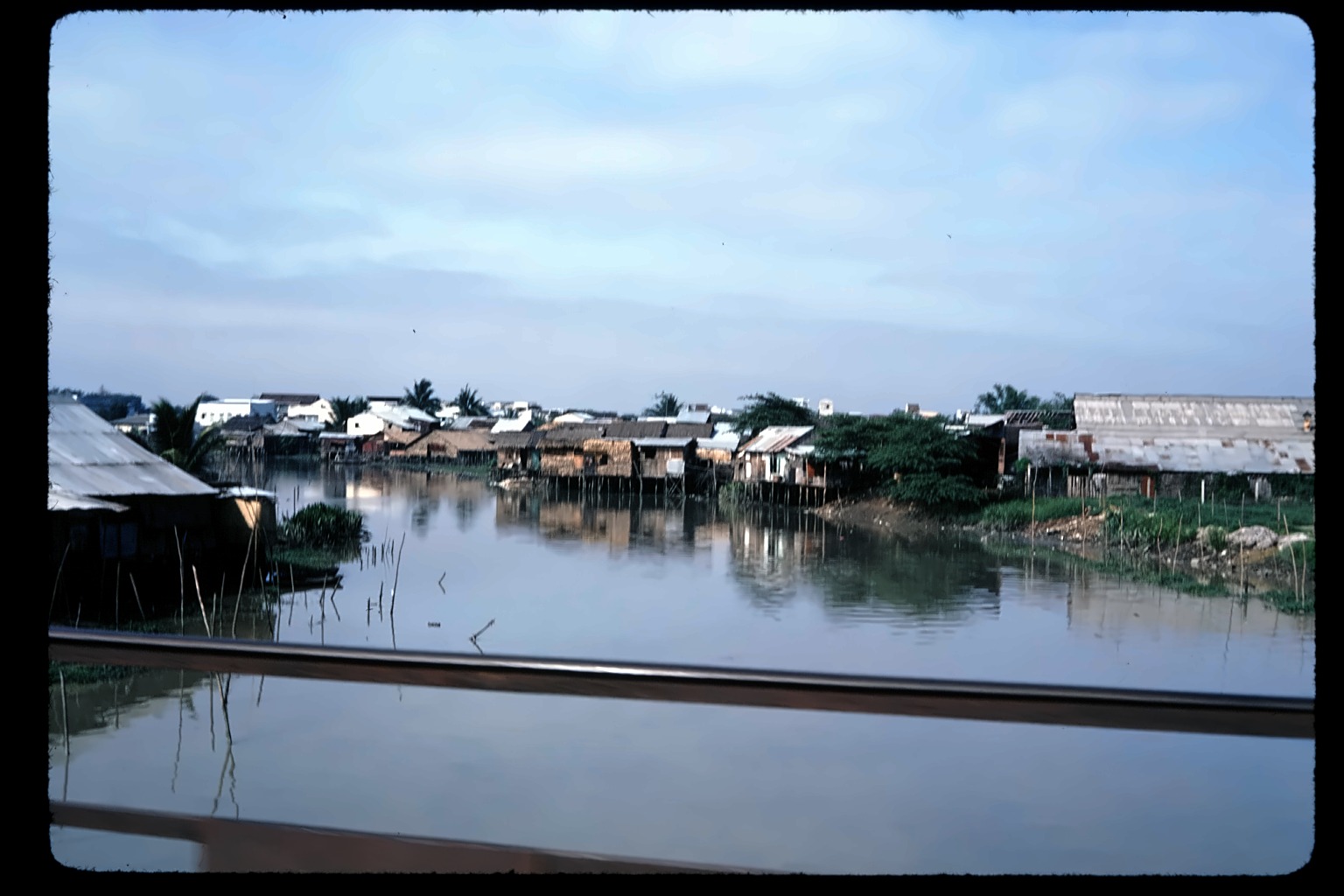
A second, separate title frame — a river scene with houseboats.
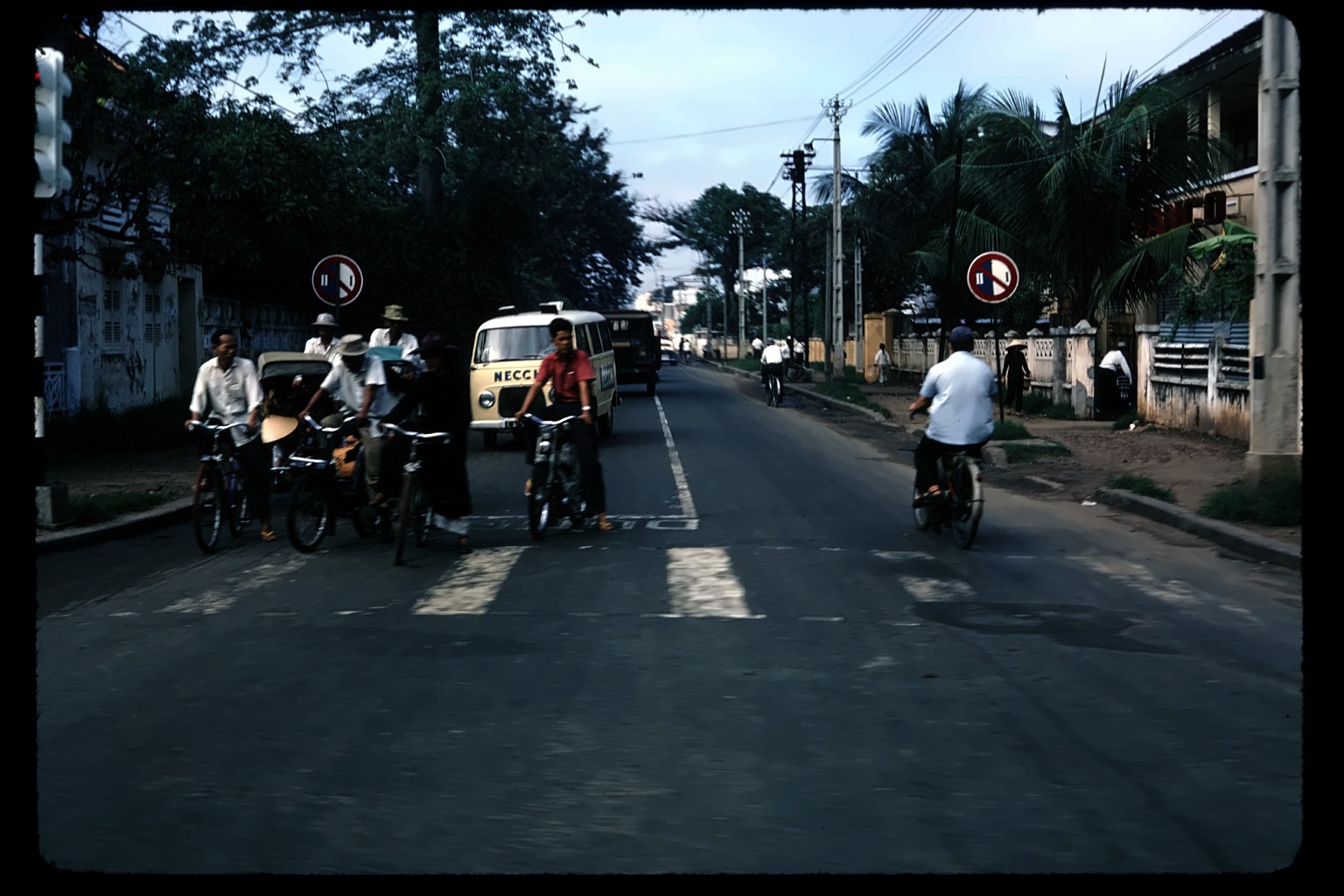
A Saigon street, motorbikes and cyclos crossing at a marked crosswalk. A VW van advertising "Necchi" — the Italian sewing machine brand — is parked mid-street.
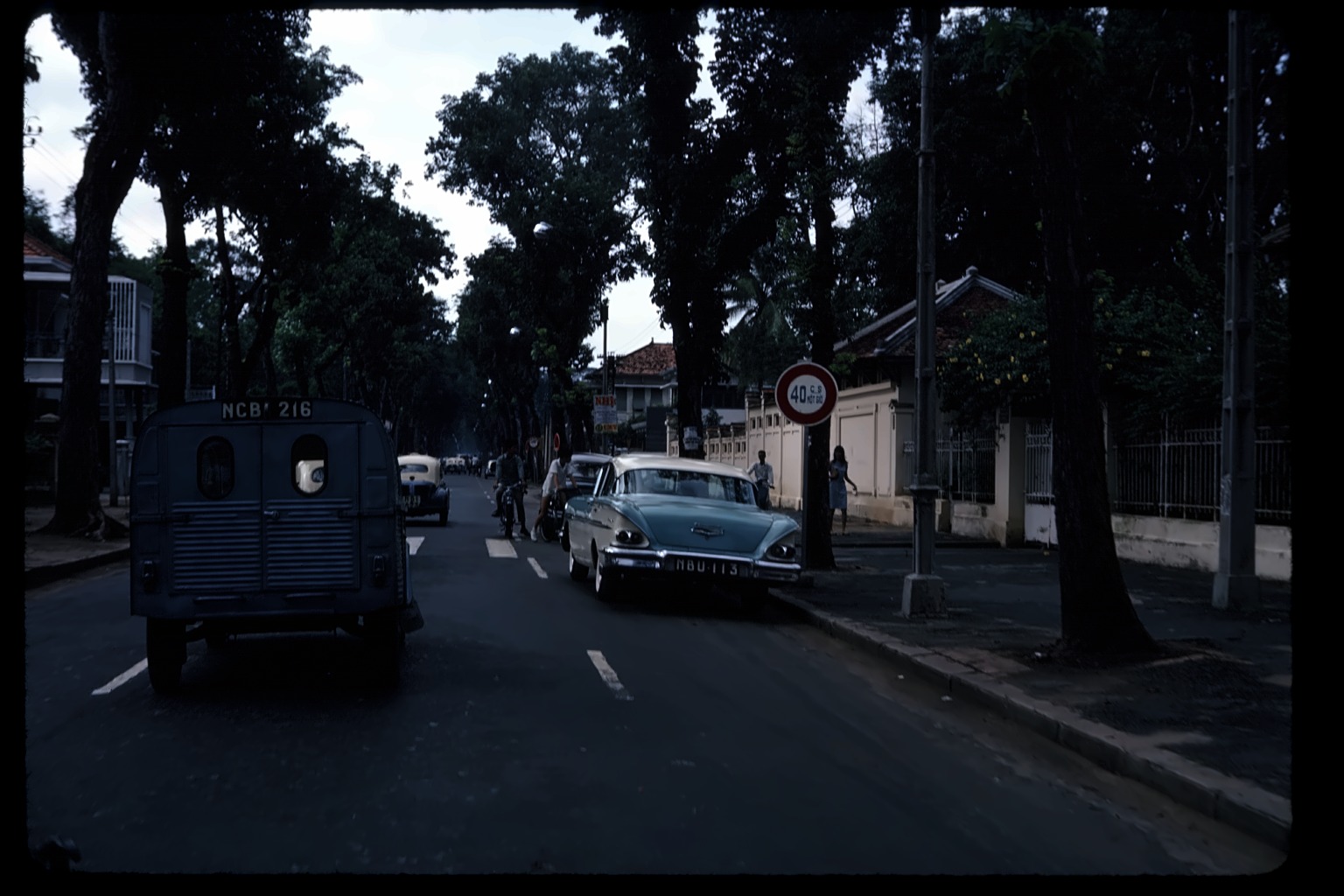
A quieter, tree-lined residential street with walled villas — a 40 km/h speed sign visible, both license plates legible (NCB 216, NBU 113).
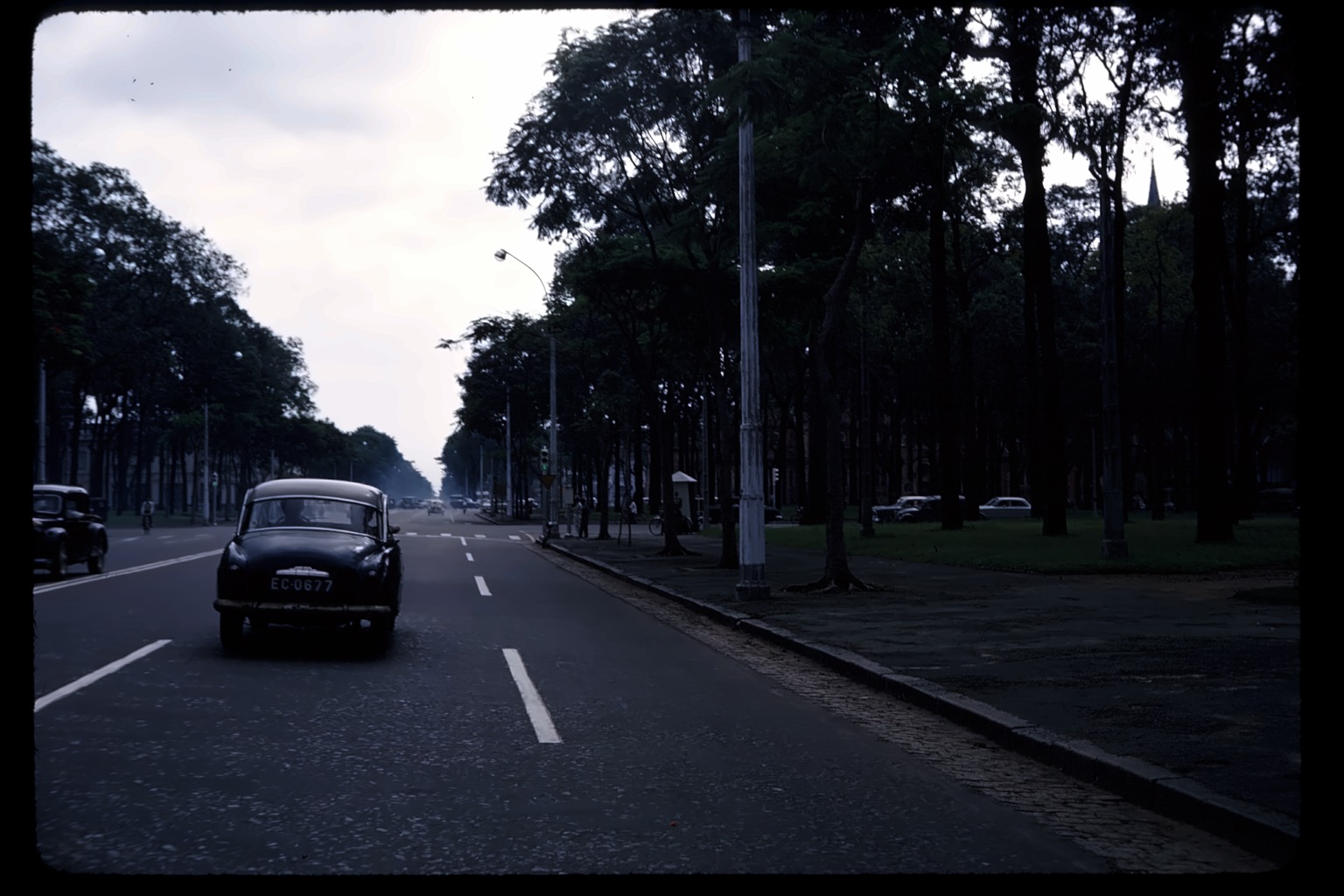
A wide, tree-lined boulevard, a church spire visible far down the street — possibly Notre-Dame Cathedral, not confirmed. The lead car's license plate is legible: EC-0677.
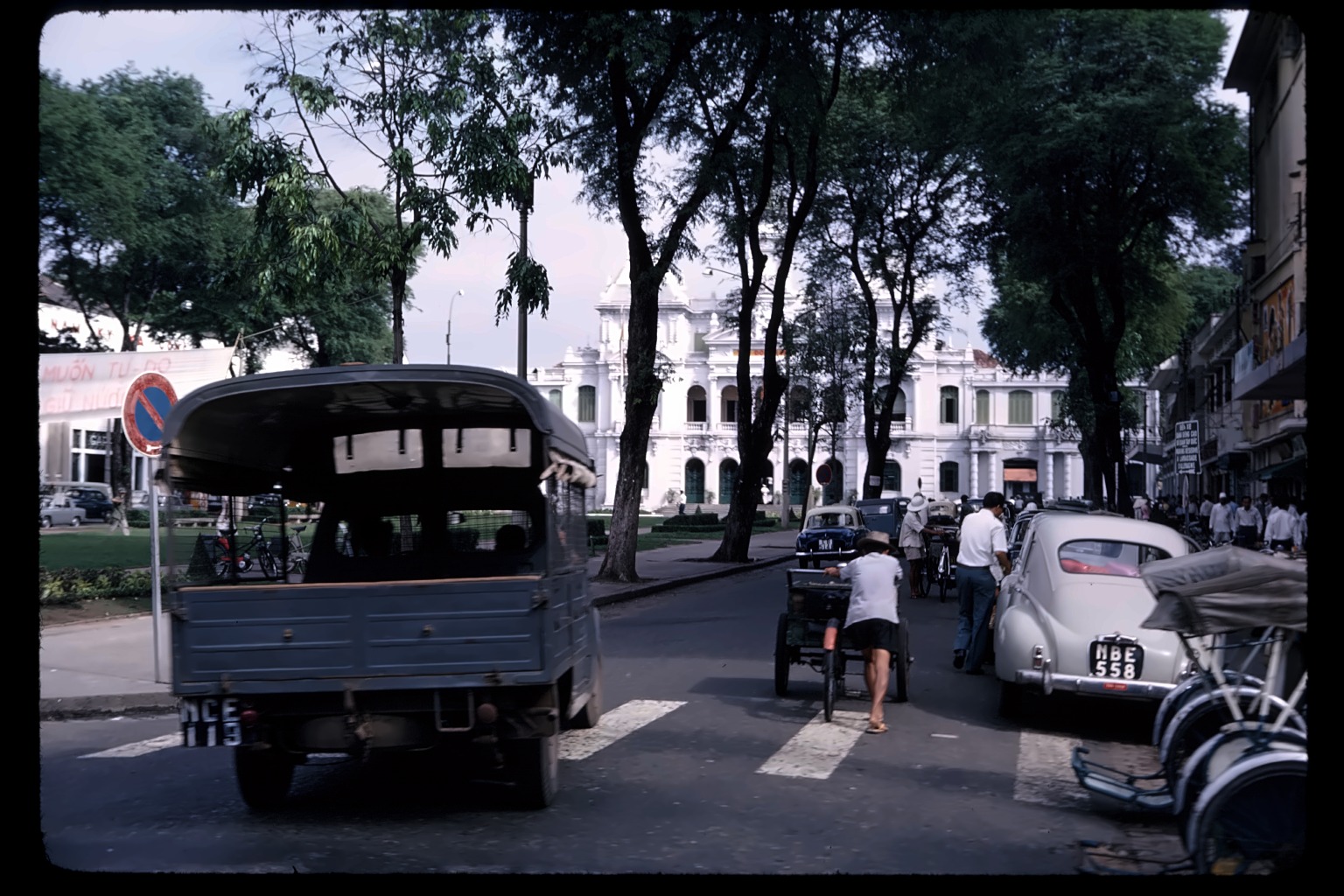
A truck and cyclo cross at a crosswalk, Saigon City Hall visible down the street — the same building confirmed head-on in slide #18, "Tòa Đô-Chánh," seen here from a side street. A partial protest banner is also visible on the left, reading "Muốn Tự Do" ("Want Freedom").
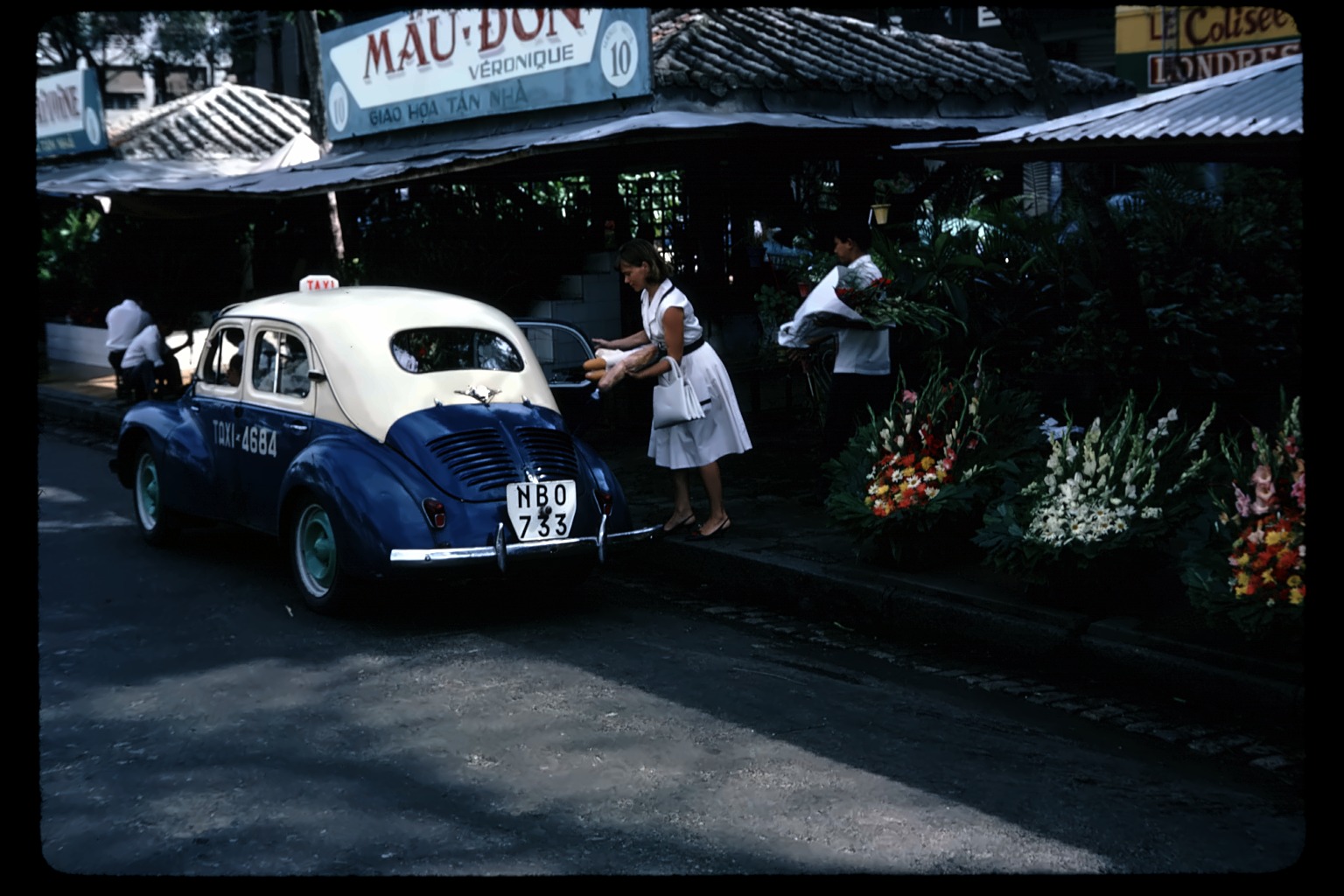
A flower stall, blooms arranged along the sidewalk.
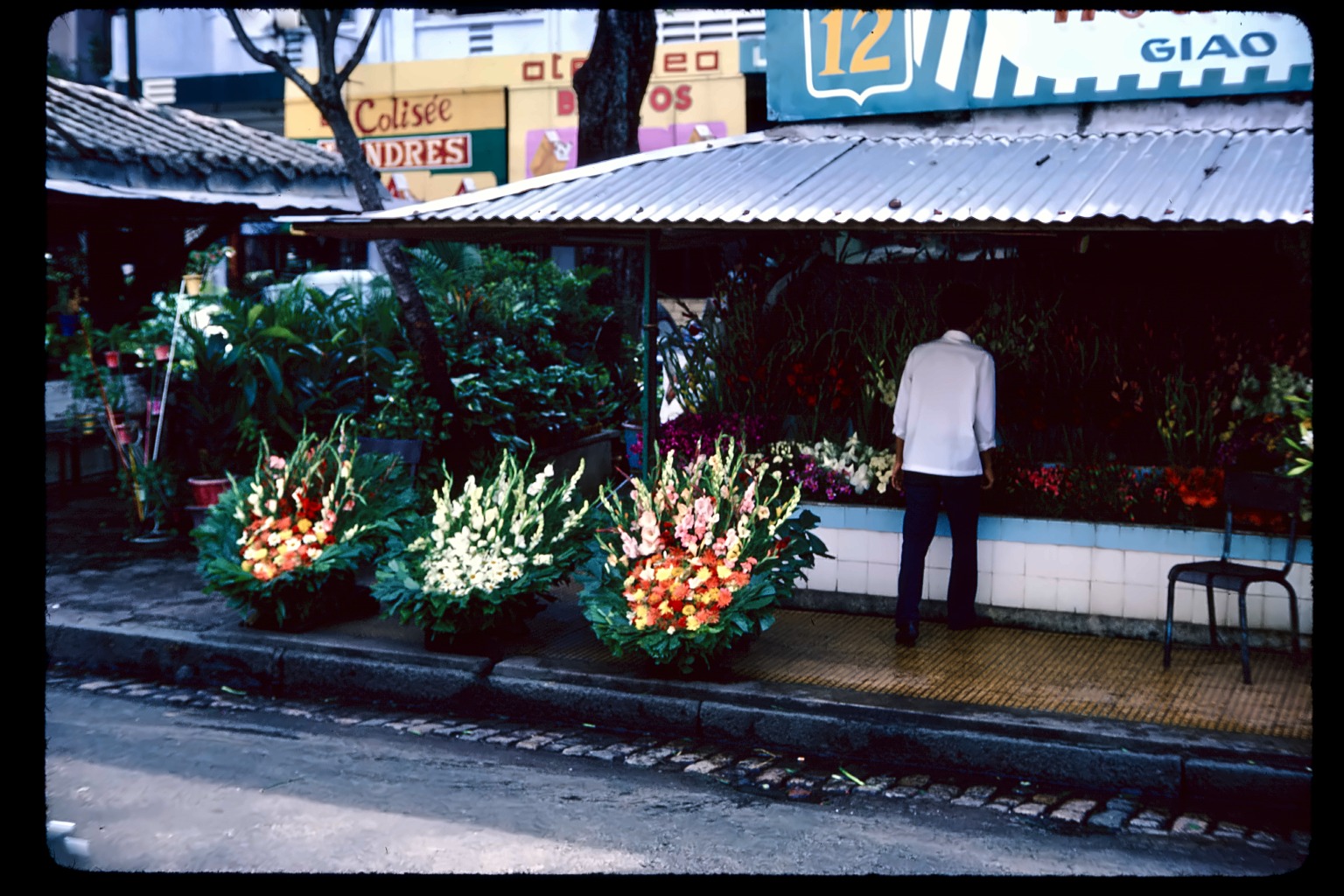
A wider view, elaborate gladiolus arrangements out front. "Colisée Londres" is legible on a shop sign in the background.
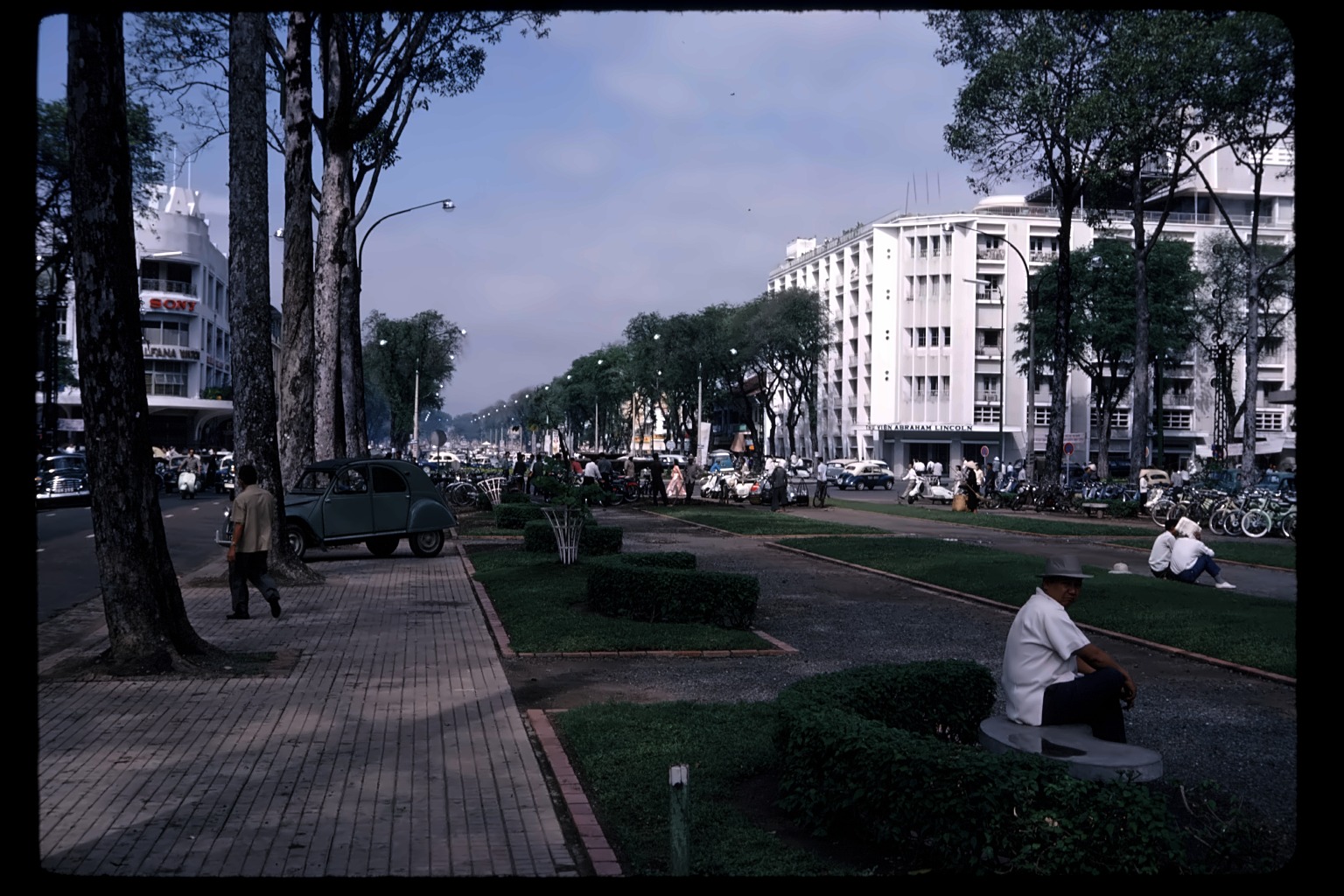
The building's sign, legible in the full-size scan, reads "Thư Viện Abraham Lincoln" — the Abraham Lincoln Library, USIS's cultural outreach institution in Saigon. This building is the Rex Complex, which housed the library from 1962 until it relocated in 1964 — a window that overlaps his own tour. Still standing today, same corner, as the Rex Hotel.
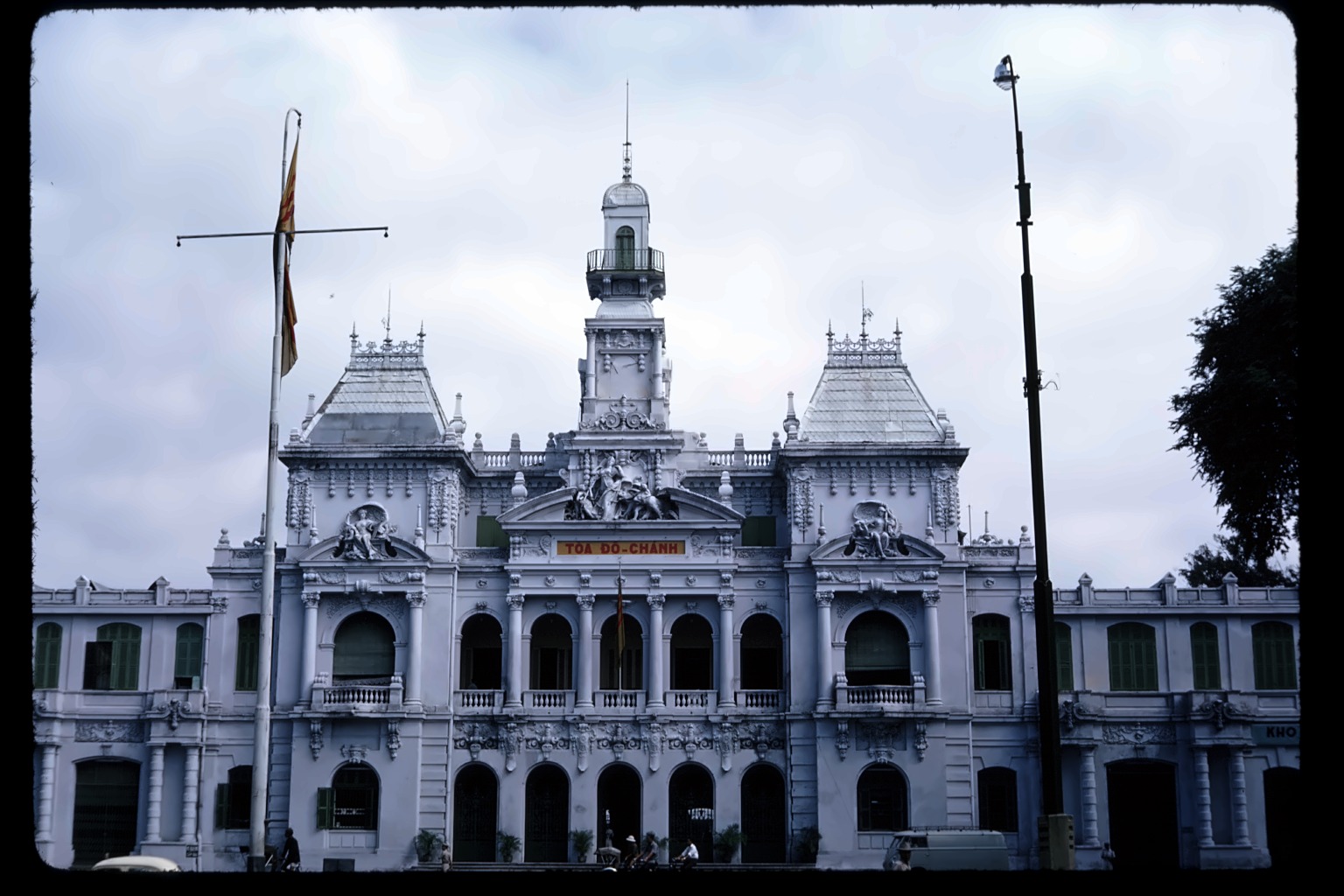
The sign reads "Tòa Đô Chánh" — Saigon City Hall, officially named that during 1954–1975, exactly his tour period. Built 1898–1909 by the French as the Hôtel de Ville de Saigon; renamed the Ho Chi Minh City People's Committee Building after 1975. Still standing, same site, about 250 meters from the Abraham Lincoln Library in slide #17 — both shot on the same walk through downtown. The same building appears again, from a side street, in slide #14.
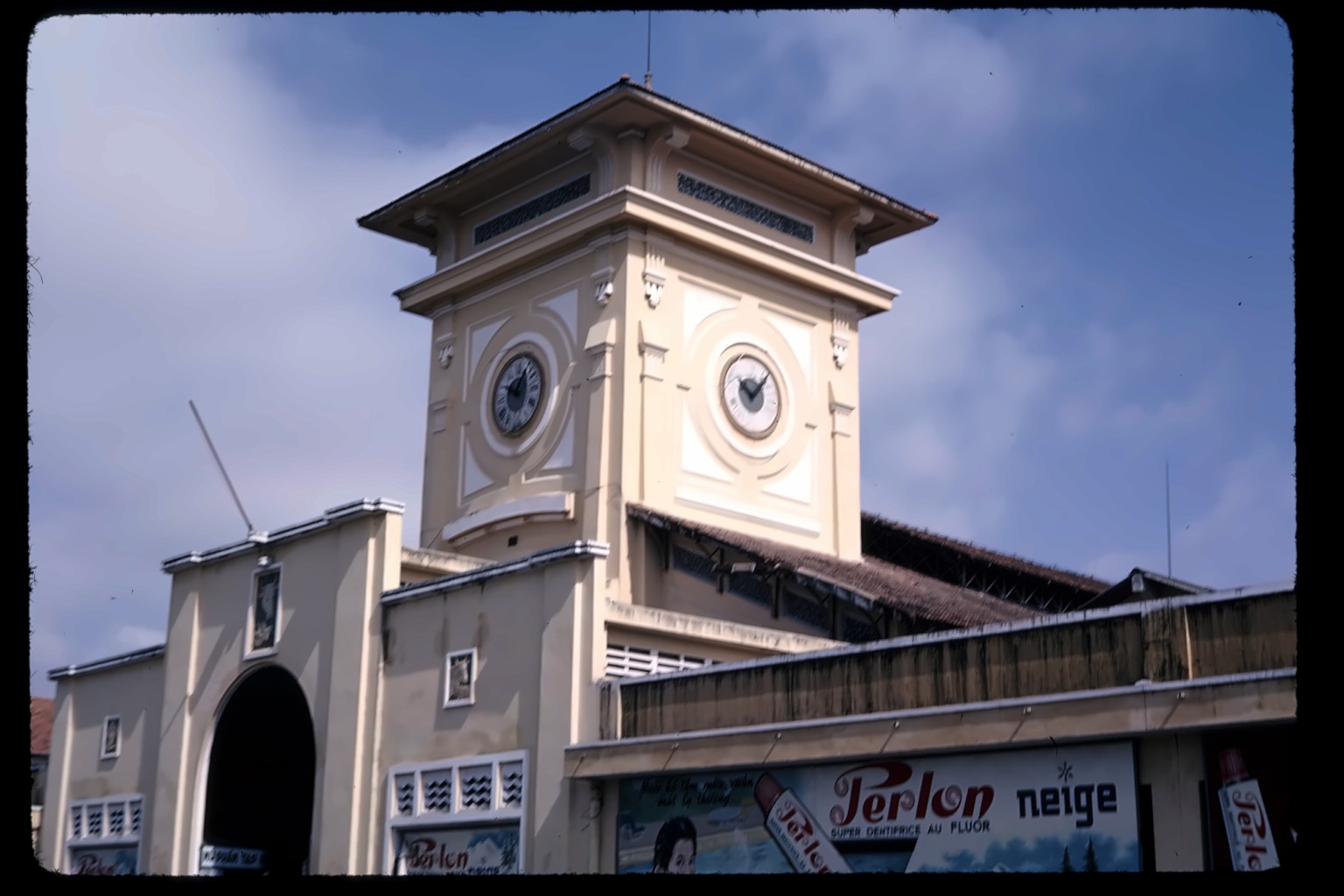
A market building with a distinctive clock tower. The streets he names — Trần Hưng Đạo and Lê Lợi — still border Bến Thành Market today, and the arched gate and tower shape are an exact match to that market's south entrance, essentially unchanged since. Confirmed.
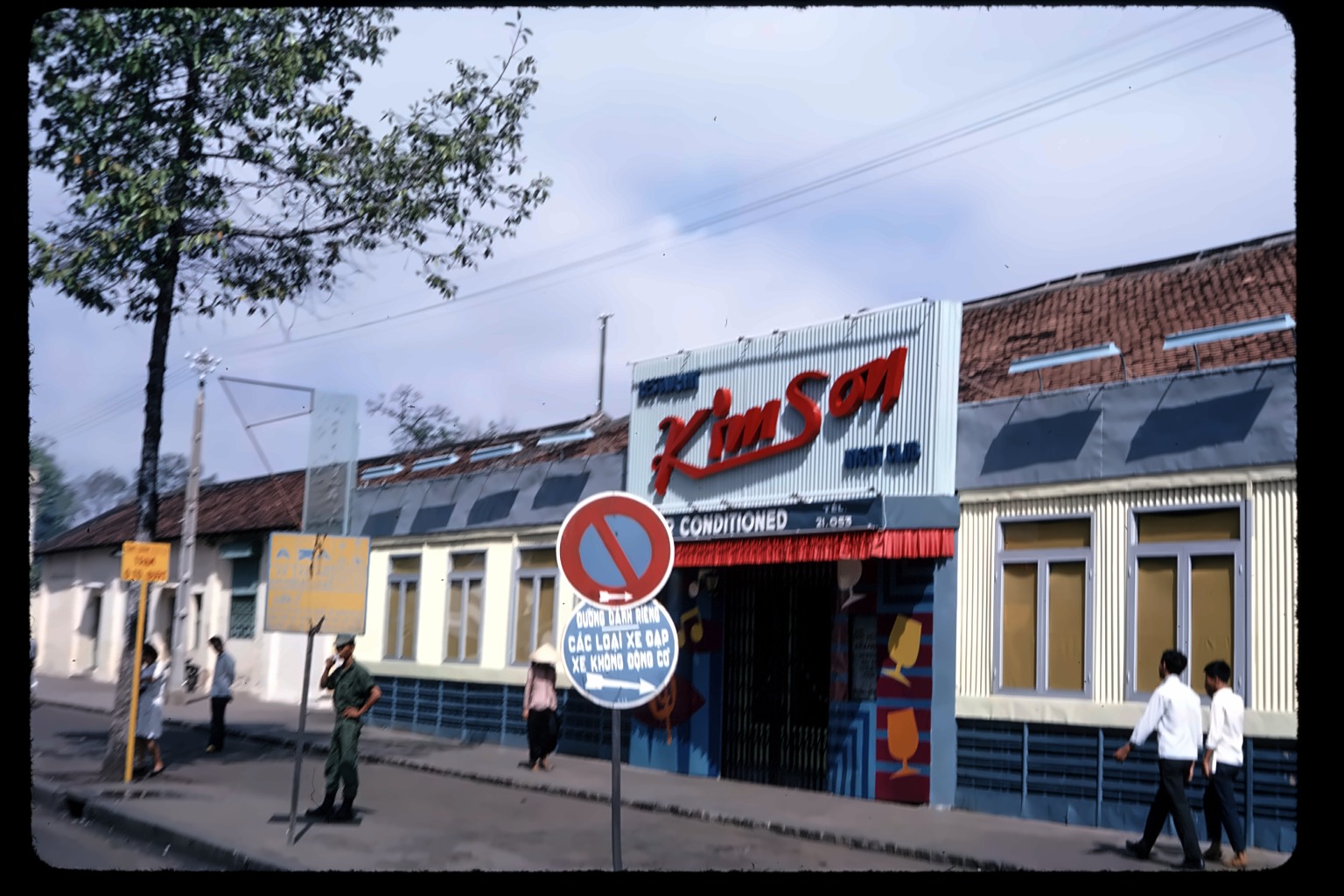
The sign is fully legible: "Kim Sơn," advertising itself as air conditioned, phone number 21-055 visible. A real, named establishment, not just generic bar signage.
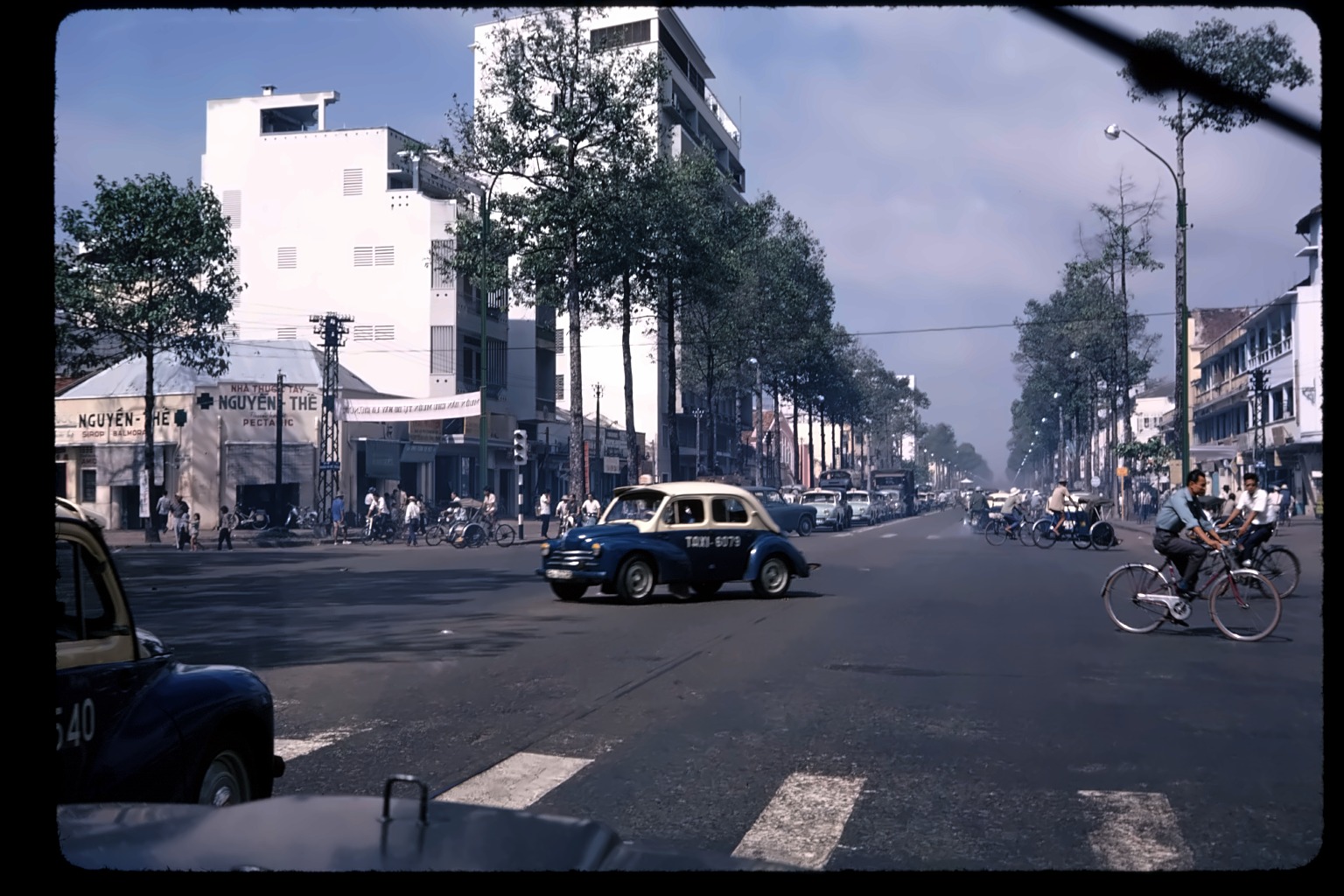
A city intersection, a taxi with "TAXI 6079" painted directly on the door. A pharmacy sign is legible: "Nhà Thuốc Tây Nguyễn-Thế," Red Cross symbol included.
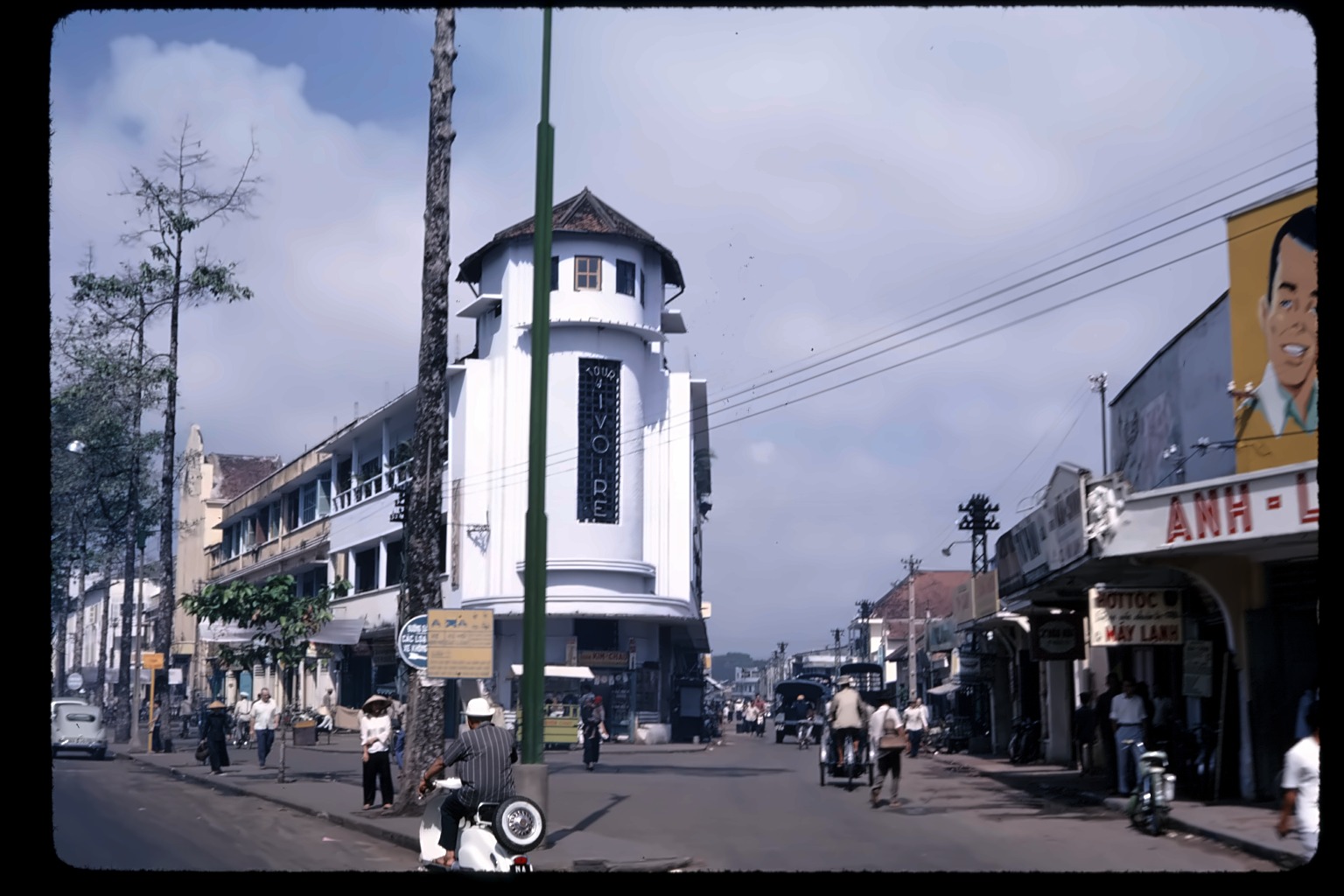
A real, named building: the Nguyễn Văn Hảo Building, Saigon's Art Deco "Flatiron," built in the 1920s–30s for automotive-parts businessman Nguyễn Văn Hảo, at the triangular junction of Trần Hưng Đạo, Ký Con, and Yersin streets in District 1, near Bến Thành Market — original address 19-21 Boulevard Galliéni. The same Nguyễn Văn Hảo also funded the nearby Nguyễn Văn Hảo Theatre, which in 1945 hosted the public meeting that launched the August Revolution in the south. Descendants of the family reportedly still live in the building today.
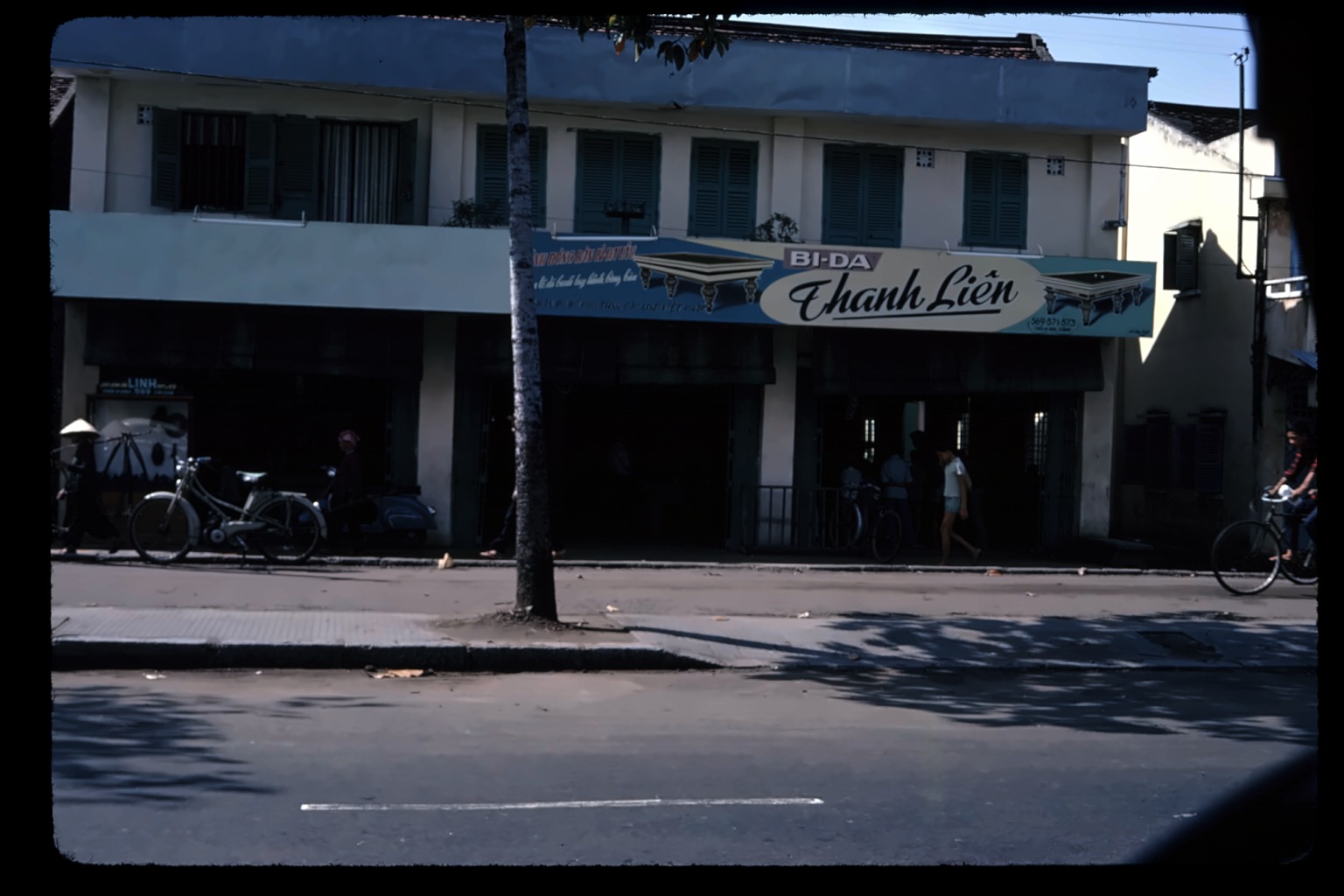
The sign is fully legible: "Bi-Da Thanh Liên" — "bi-da" is Vietnamese for billiards — a real named hall, phone number visible on the sign.
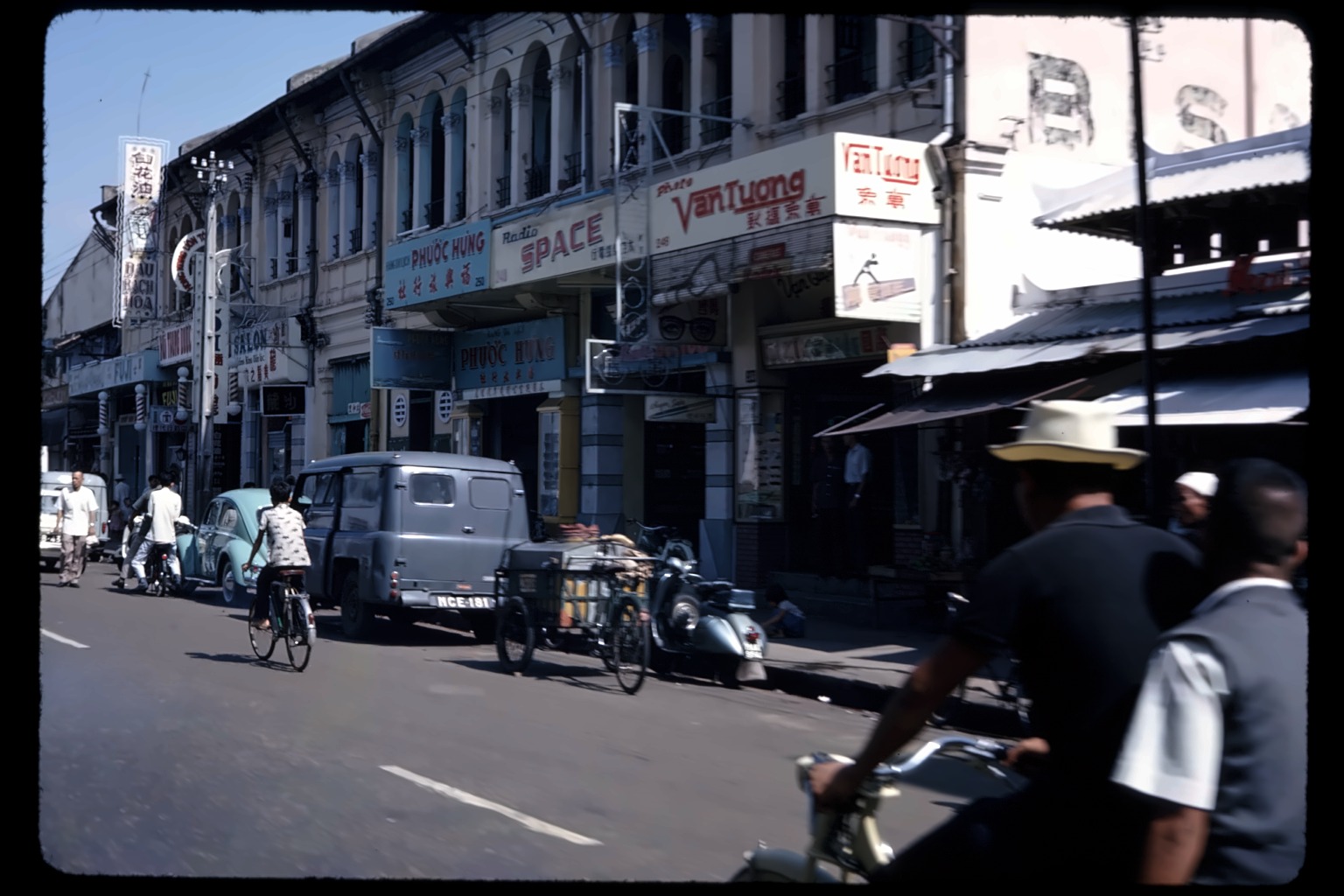
Real named shops, several fully legible: "Photo Văn Tường" (with a camera icon on its sign), "Phước Hưng," "Radio Space" — a genuine commercial strip, not generic storefronts.
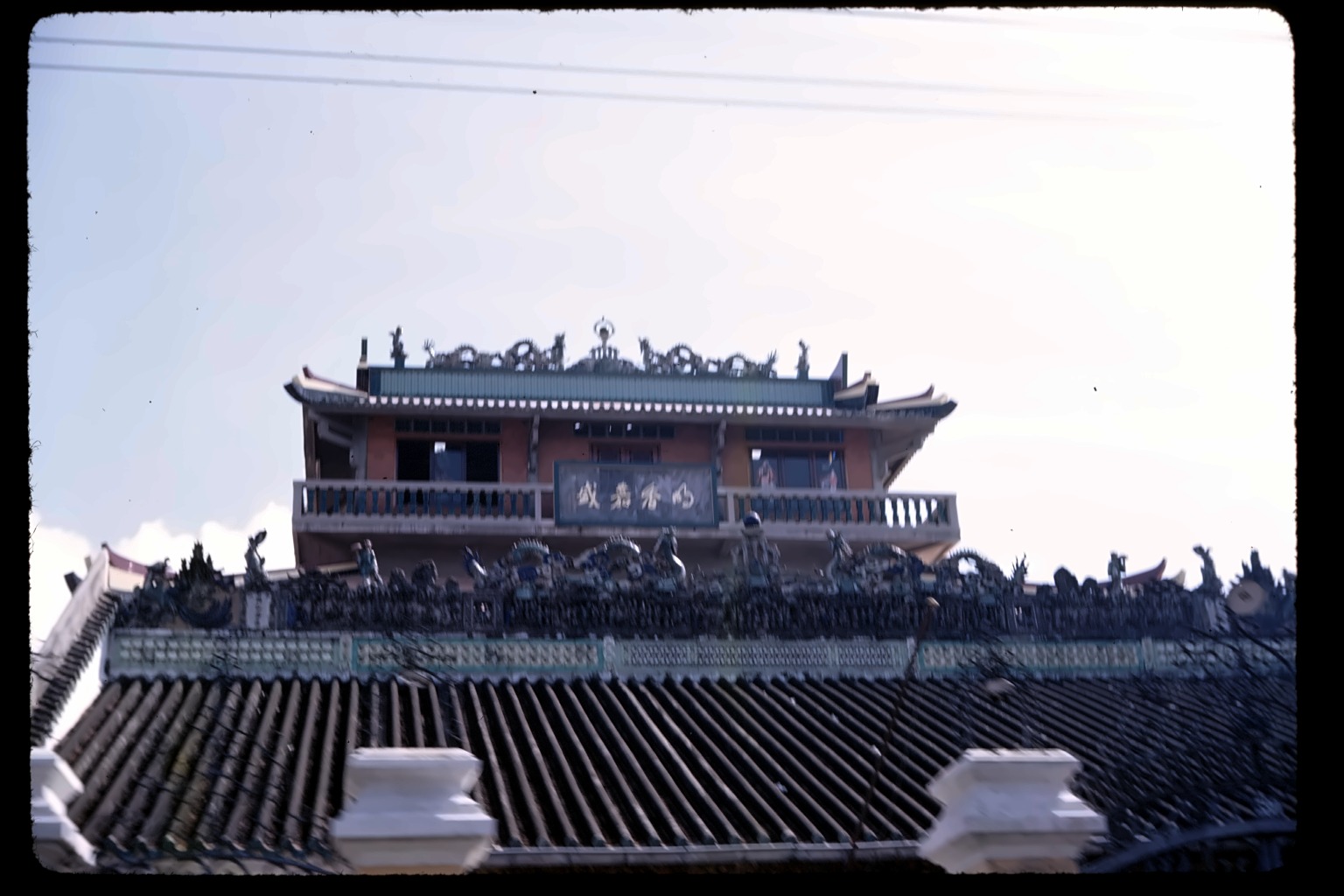
A genuinely elaborate Chinese-style temple, roof ridge crowded with figurine decoration, a Chinese-character sign on the upper facade — likely a Cholon temple given the style, not a Vietnamese Buddhist pagoda specifically.
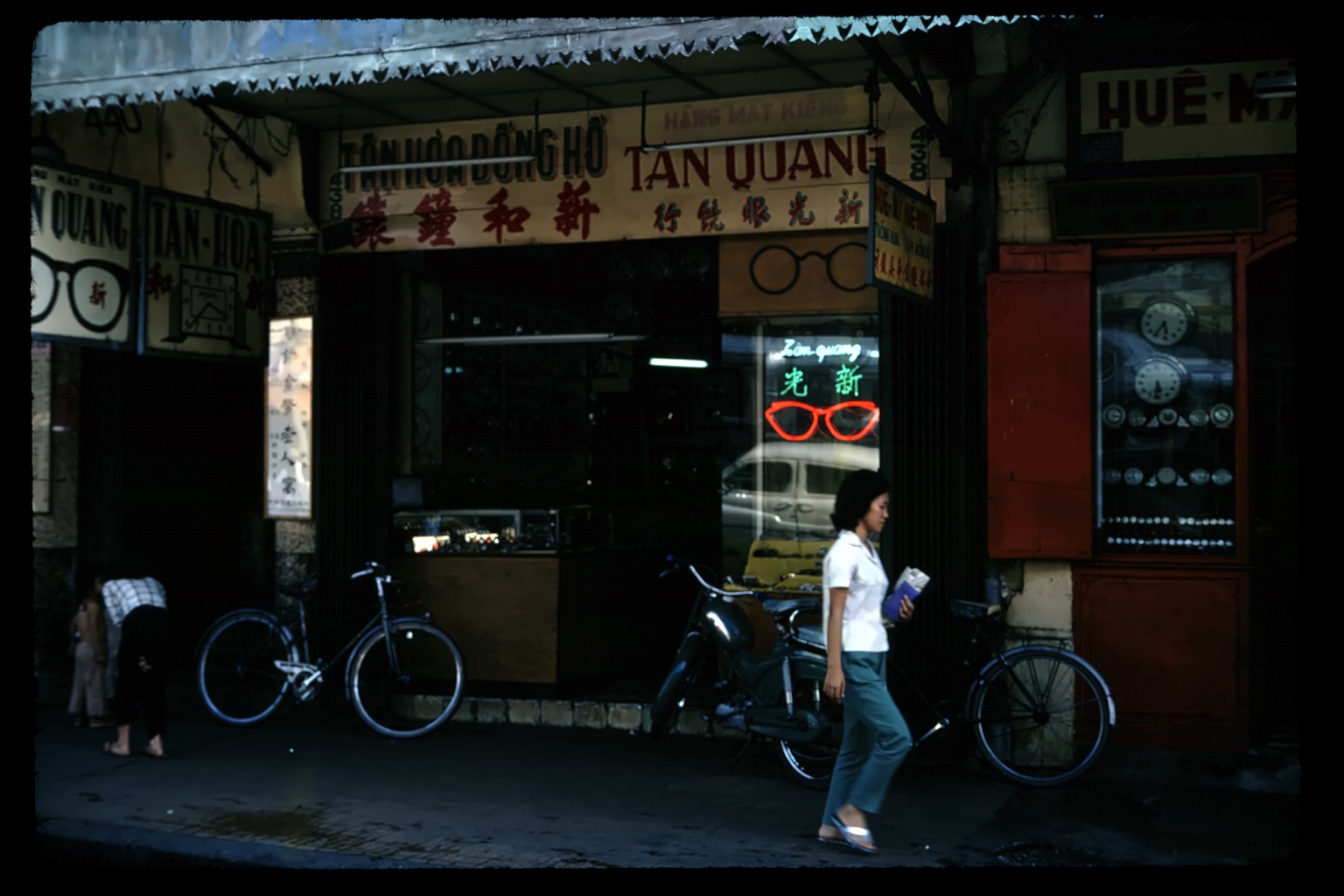
Fully legible: two real named shops side by side — "Tân Quang," an optician with a neon glasses sign, and "Tân Hòa Đồng Hồ," a watch and clock shop. A woman crosses in front, matching his caption.
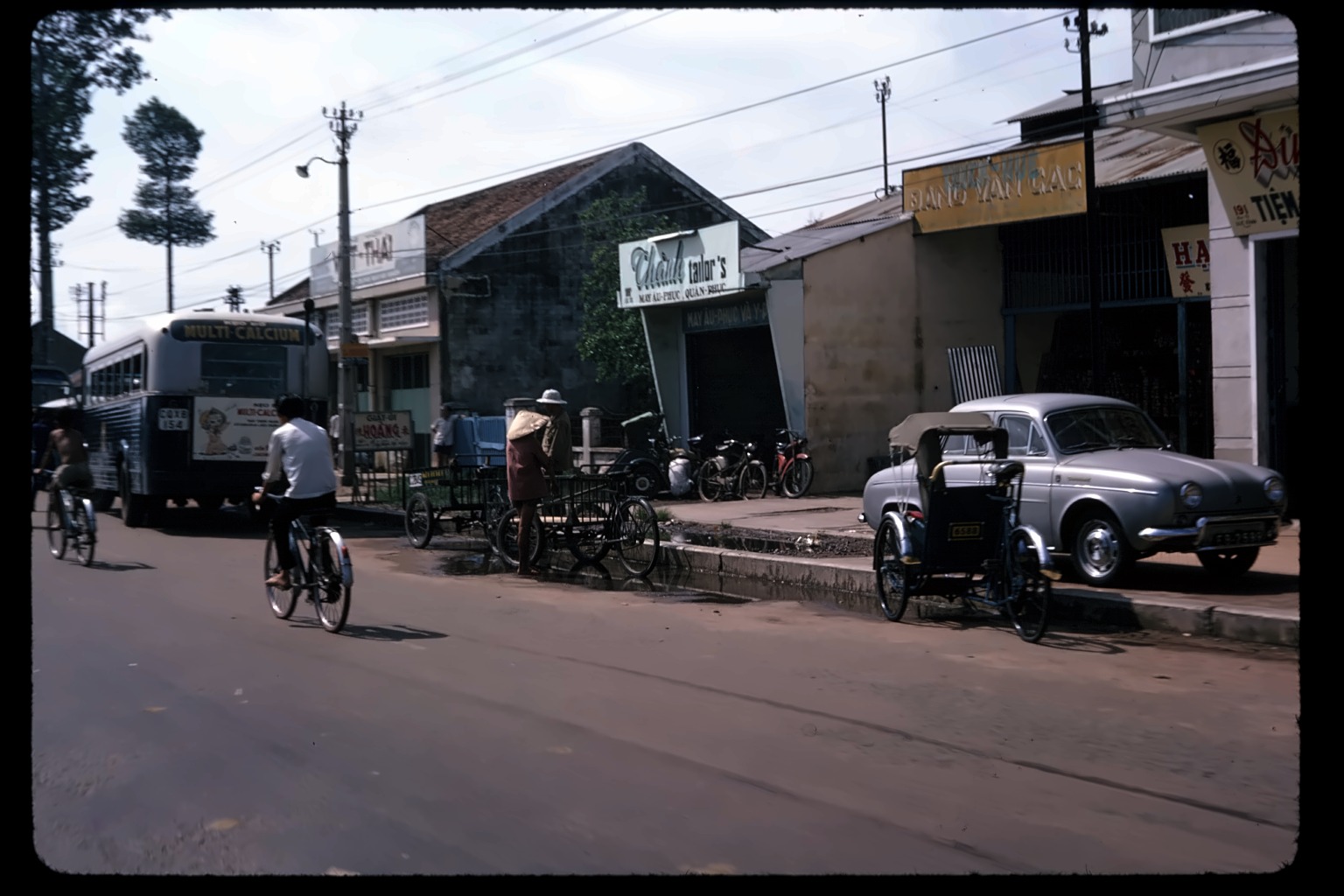
A named tailor's shop, "Chánh Tailor's," fully legible, and a public bus with a "Multi-Calcium" advertisement painted on its side.
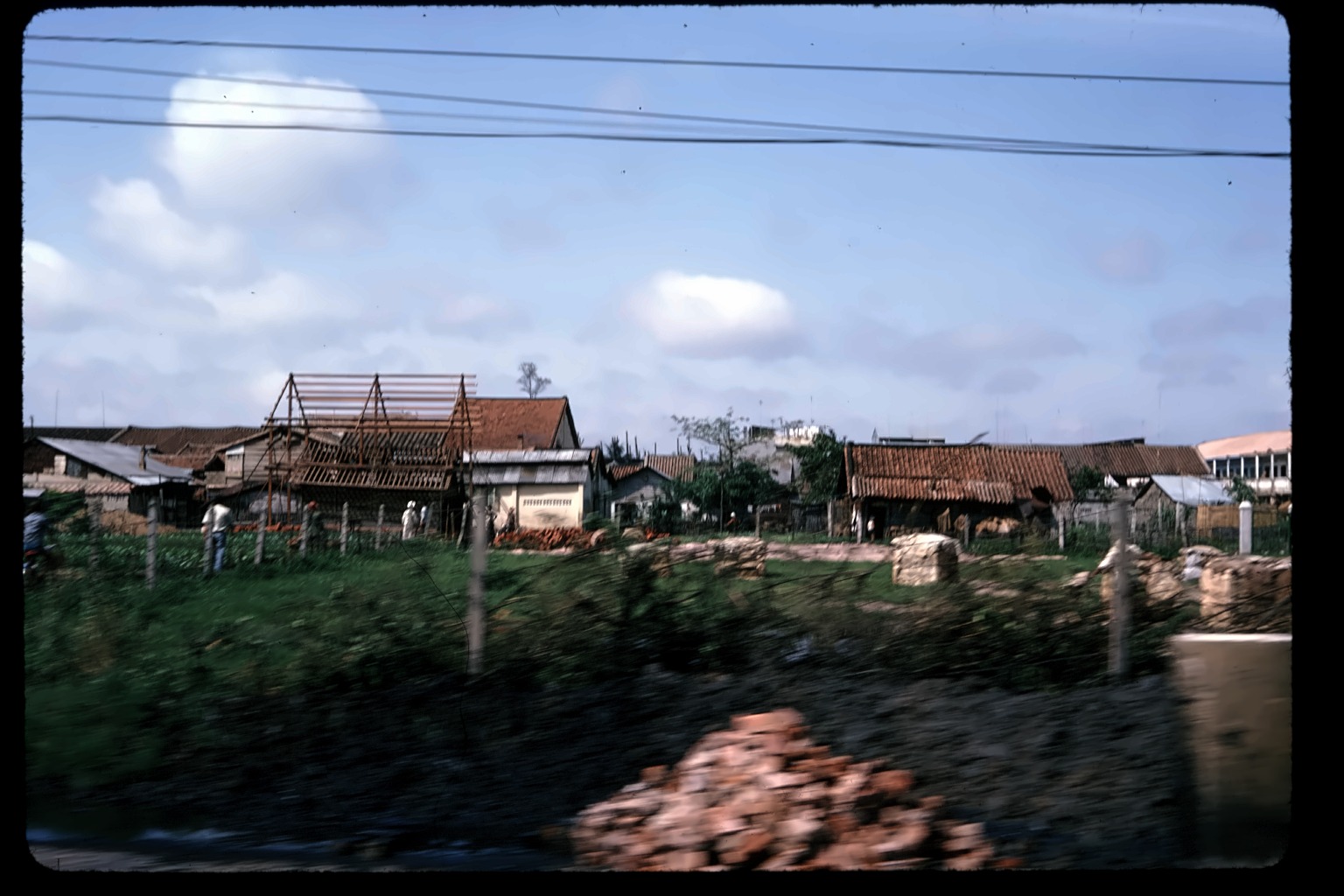
The edge of the city — a house under construction, roof framing exposed mid-build, tile-roofed homes beyond it.
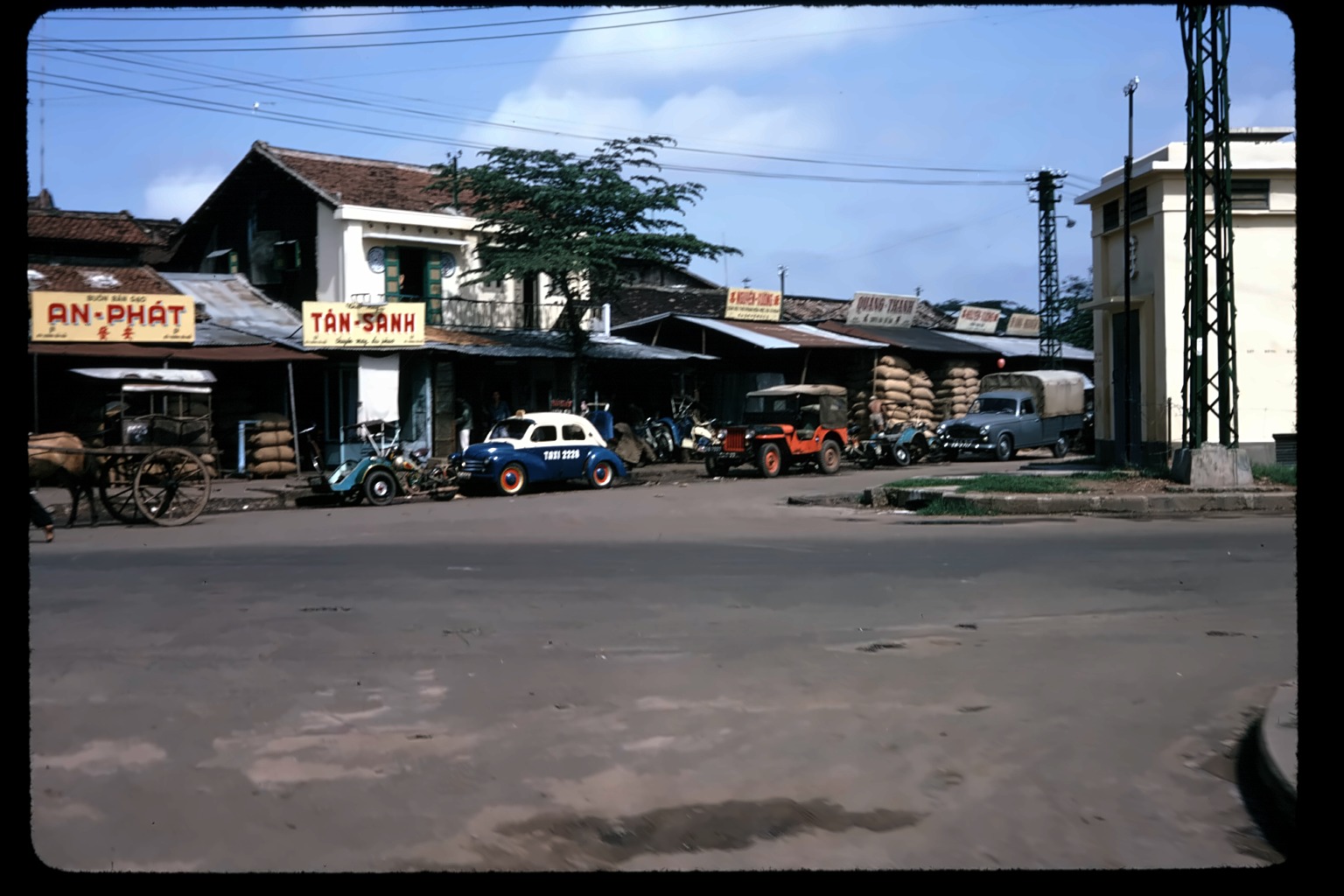
An ox cart in the foreground, multiple named shops fully legible: "An-Phát," "Tân-Sanh," and more further down the row. A taxi marked "TAXI 2228," sacks of rice or grain stacked outside a market building.
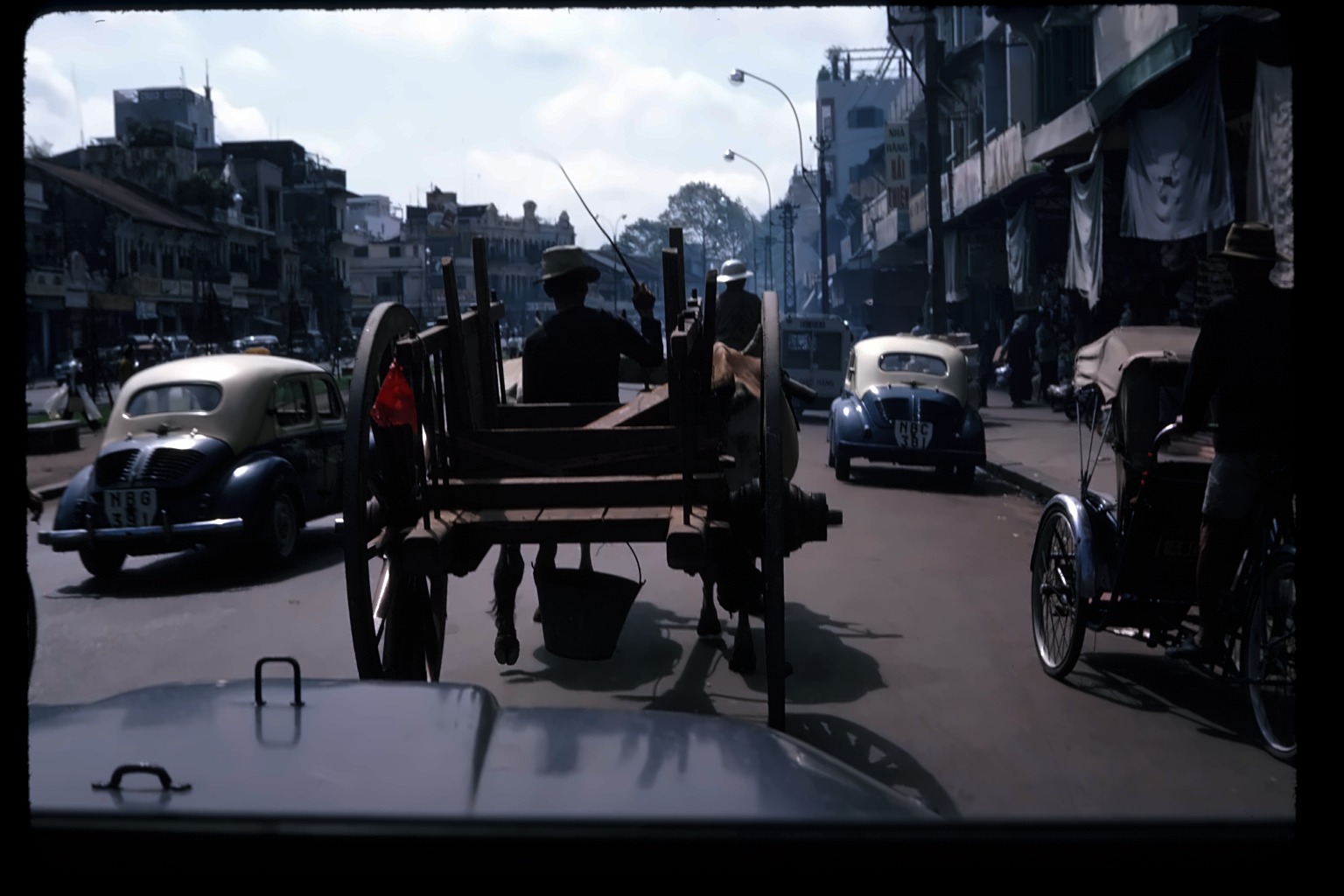
A horse-drawn cart on a busy street, a distinctive corner-tower building visible far down the block — the same shape as the "Ivoire" building in slide #22. License plates legible: NBG 391, NBC 3?1.
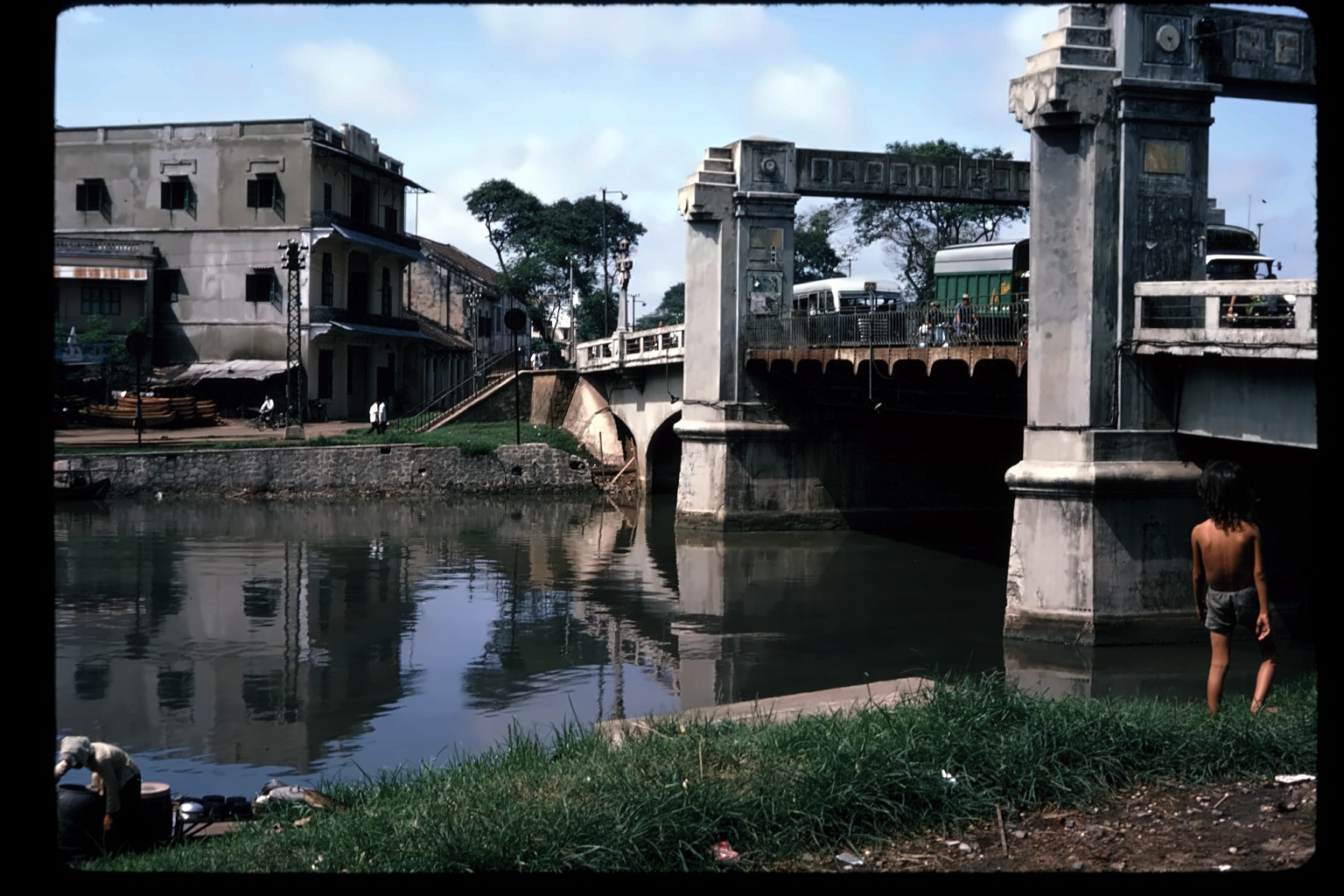
A monumental bridge on sculpted concrete piers, three police officers visible near the near bank. "Can Oi" is almost certainly his phonetic spelling of Khánh Hội, a real district across the Bến Nghé Creek — its old bridge was demolished in 1961 and replaced by the reinforced-concrete Khánh Hội Bridge, built just a couple of years before this photo. That specific bridge no longer exists (demolished 2009), so this isn't a pixel-confirmed match, but the timing and construction style line up well.
likely Khánh Hội Bridge — not fully confirmed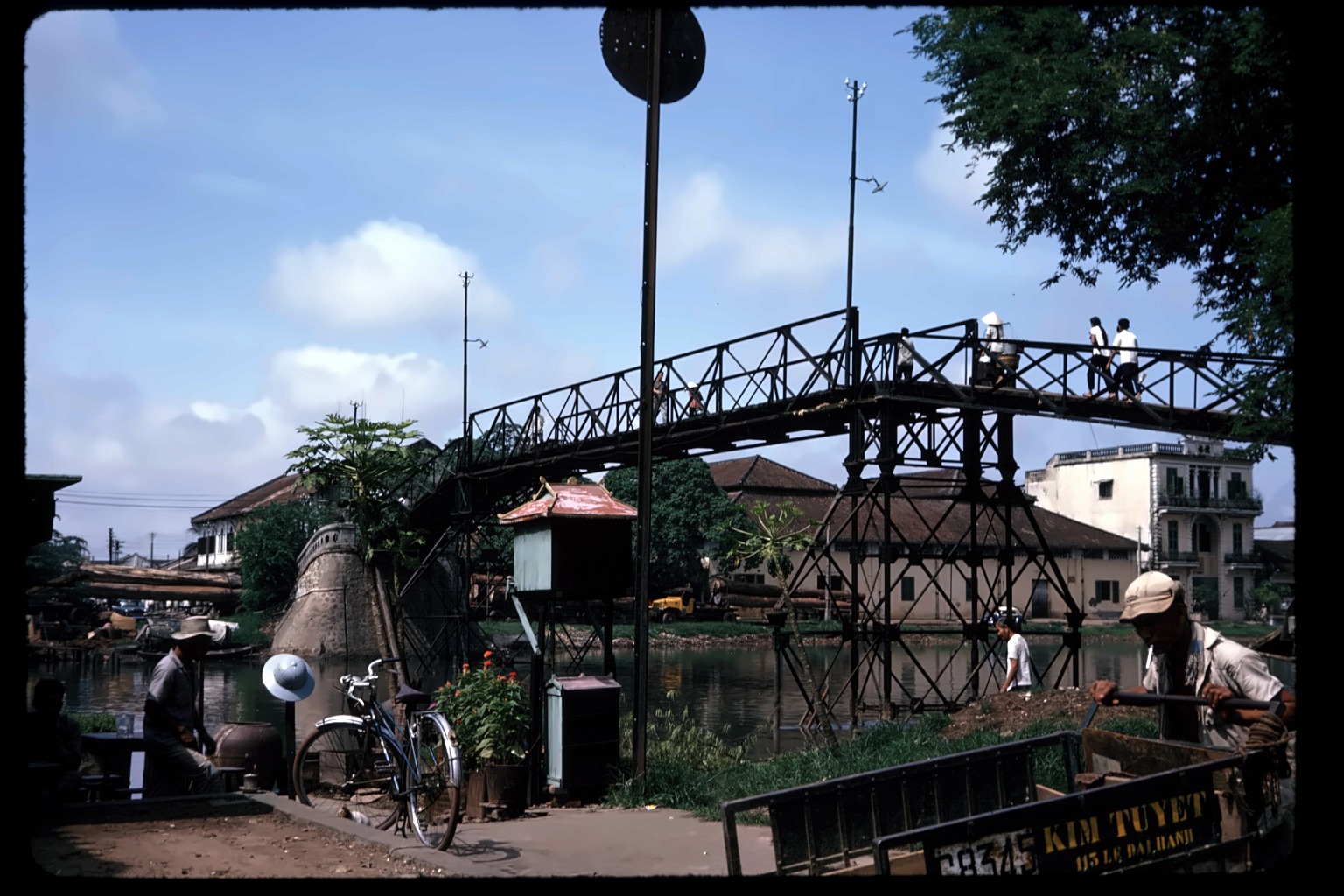
Same crossing as #31, same place name spelled differently — both point to Khánh Hội.
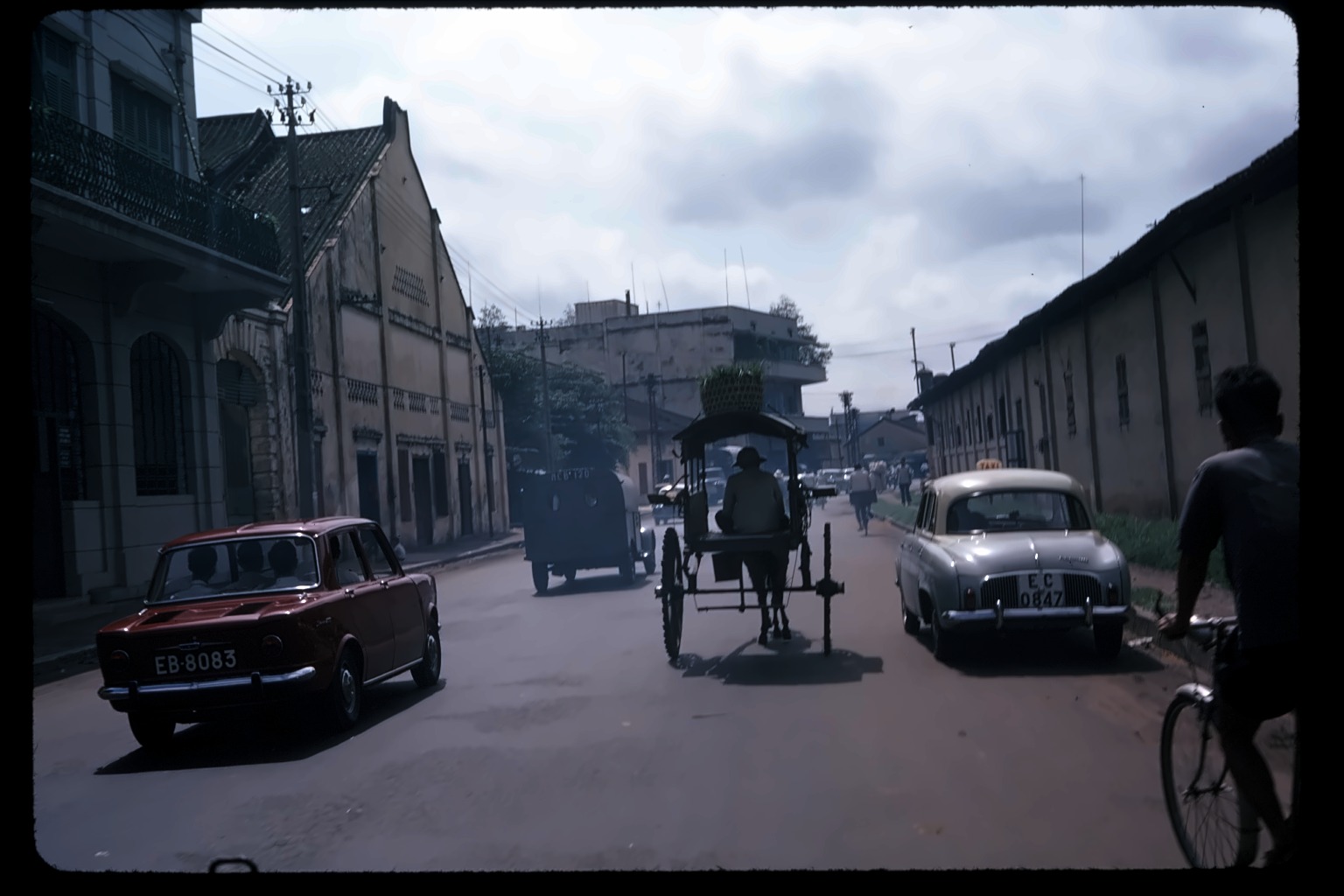
A street lined with distinctive shophouse architecture, likely Cholon — a taxi and multiple cars visible, license plates legible (EB-8083, EC-0847).
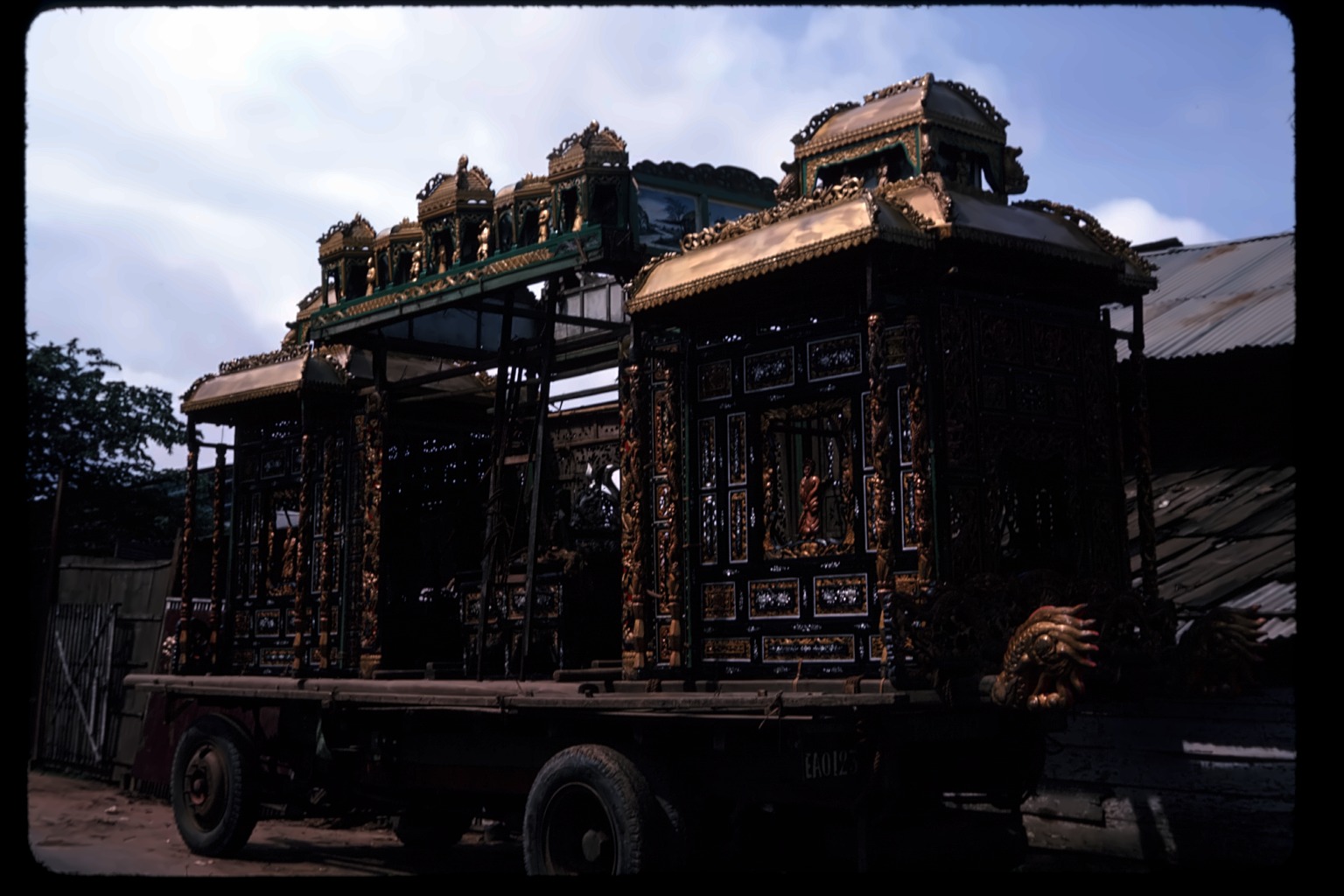
An elaborately carved wooden funeral hearse.
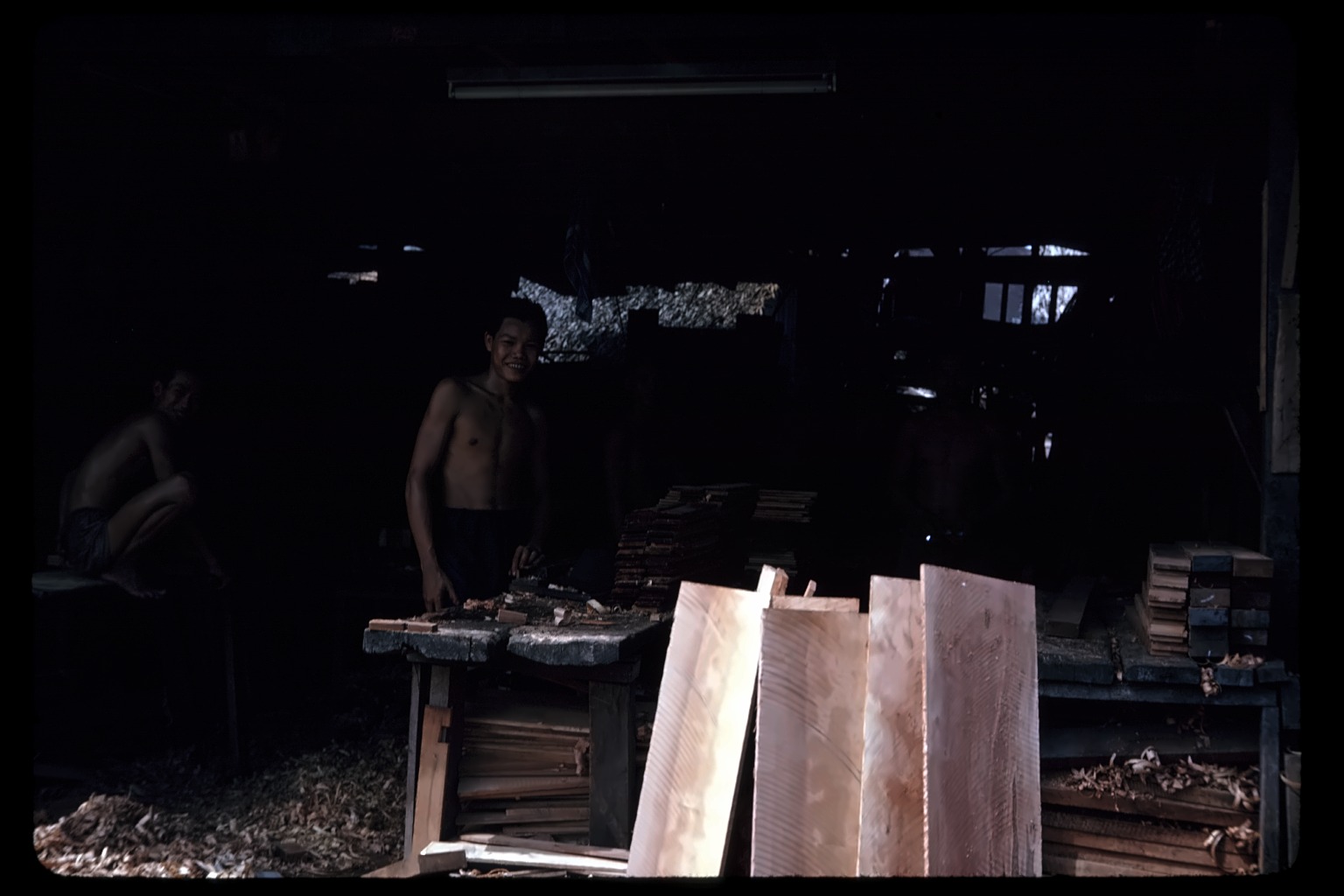
Two men at work in a woodworking shop.
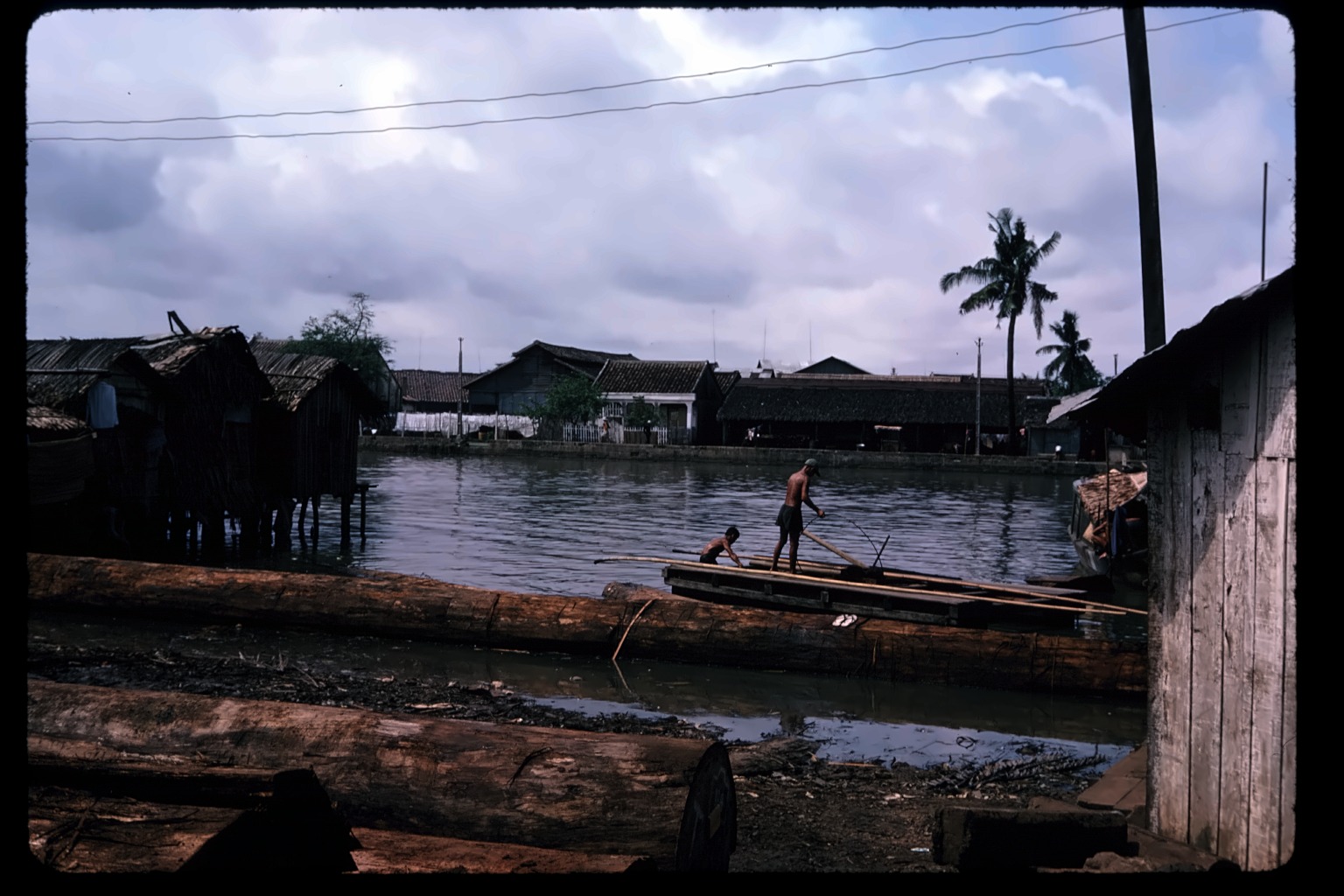
Timber pulled from the river, a boat nearby.
A nursery or plant stall — this frame came out very dark.
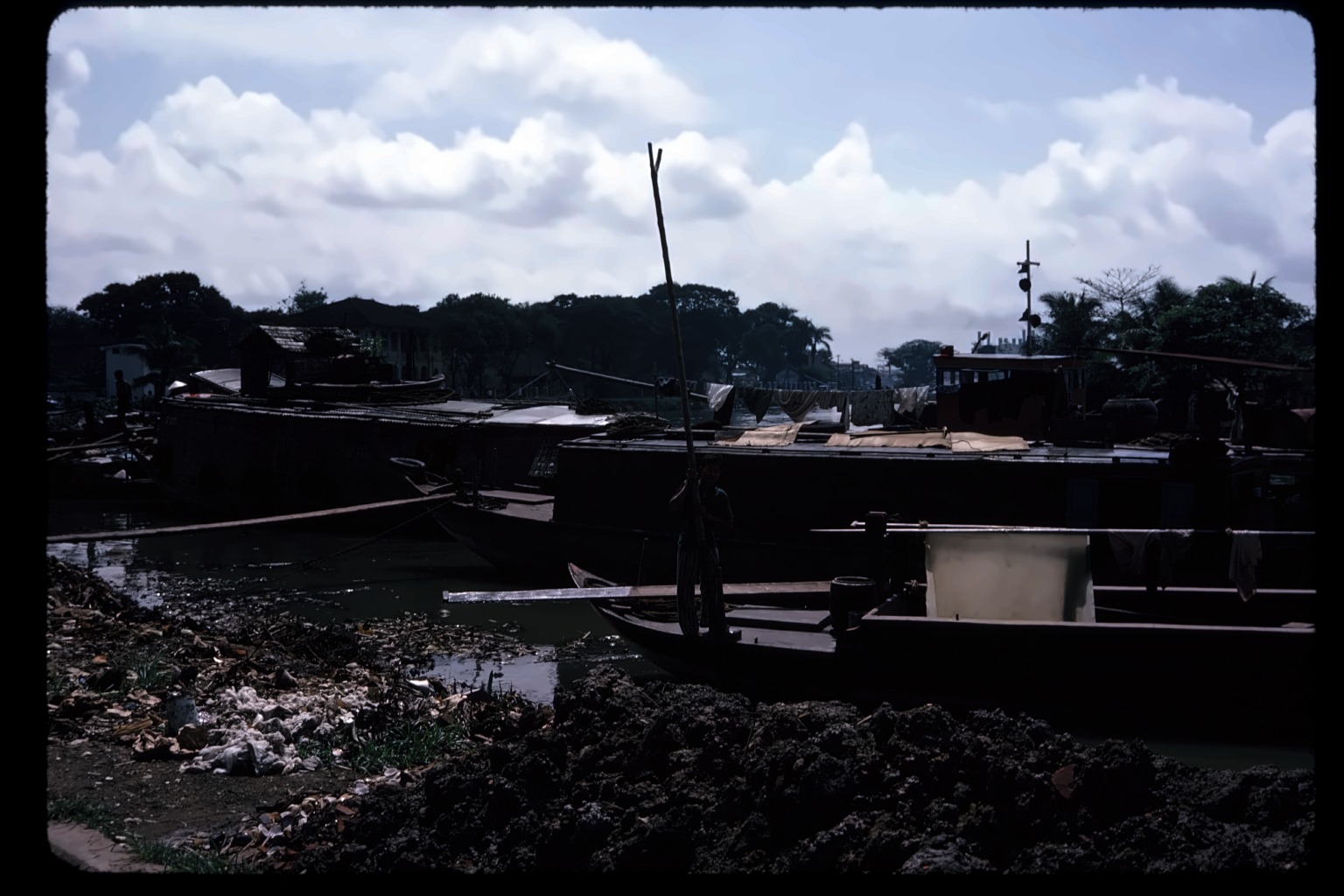
Boats along a riverbank.
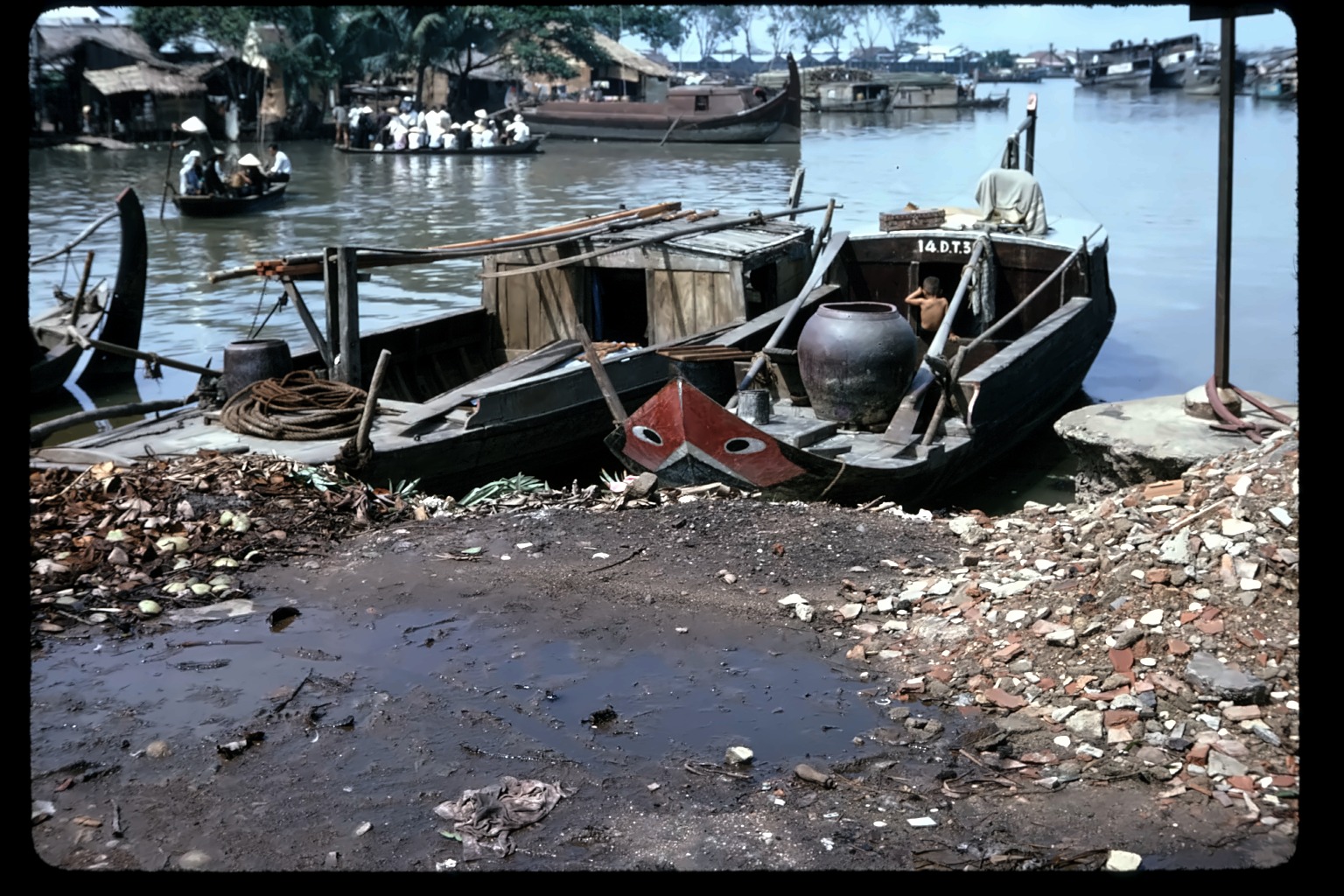
More riverboats, debris and refuse along the shoreline he's noting directly in the caption.
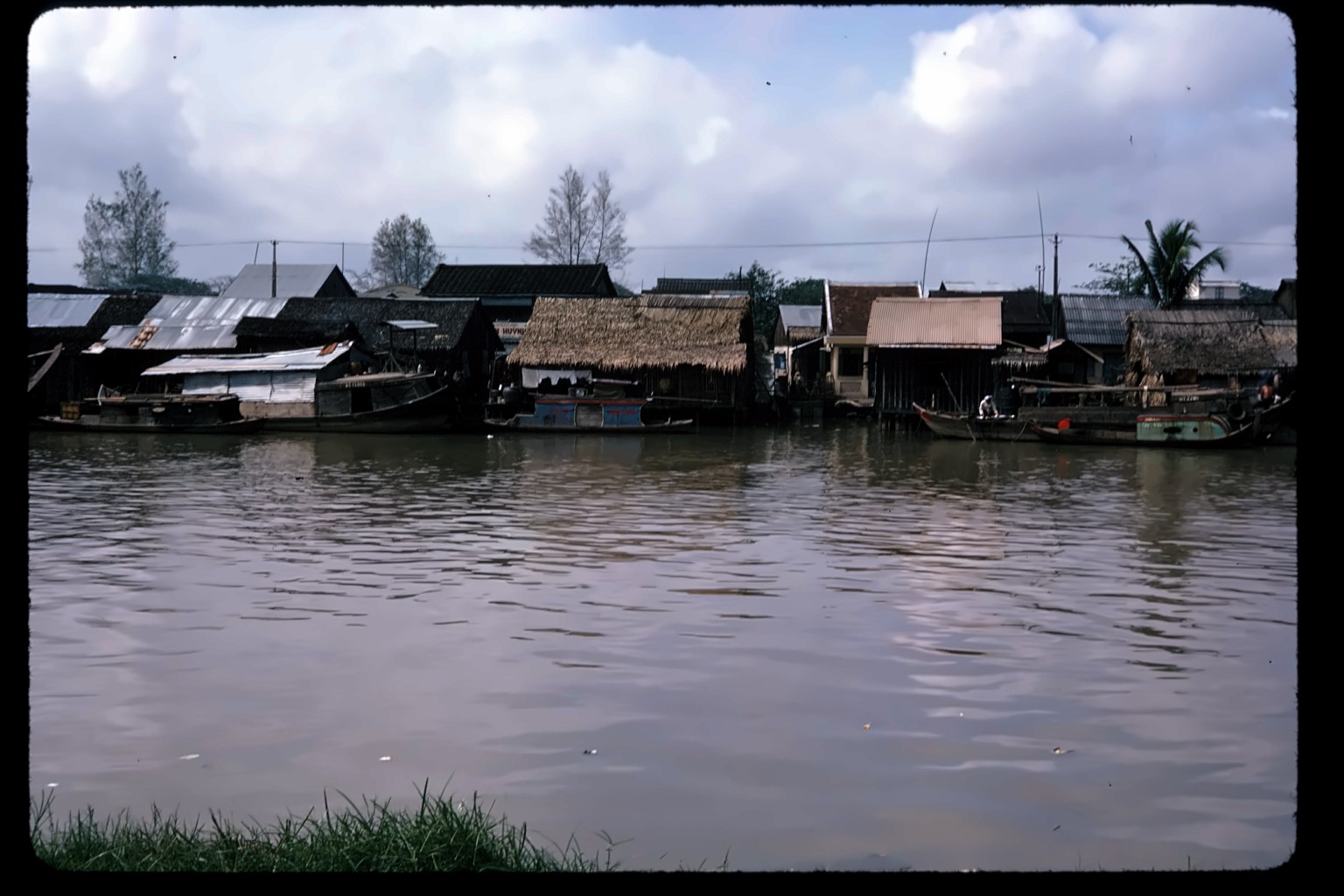
A wide view over the water, boats moored along the far bank.
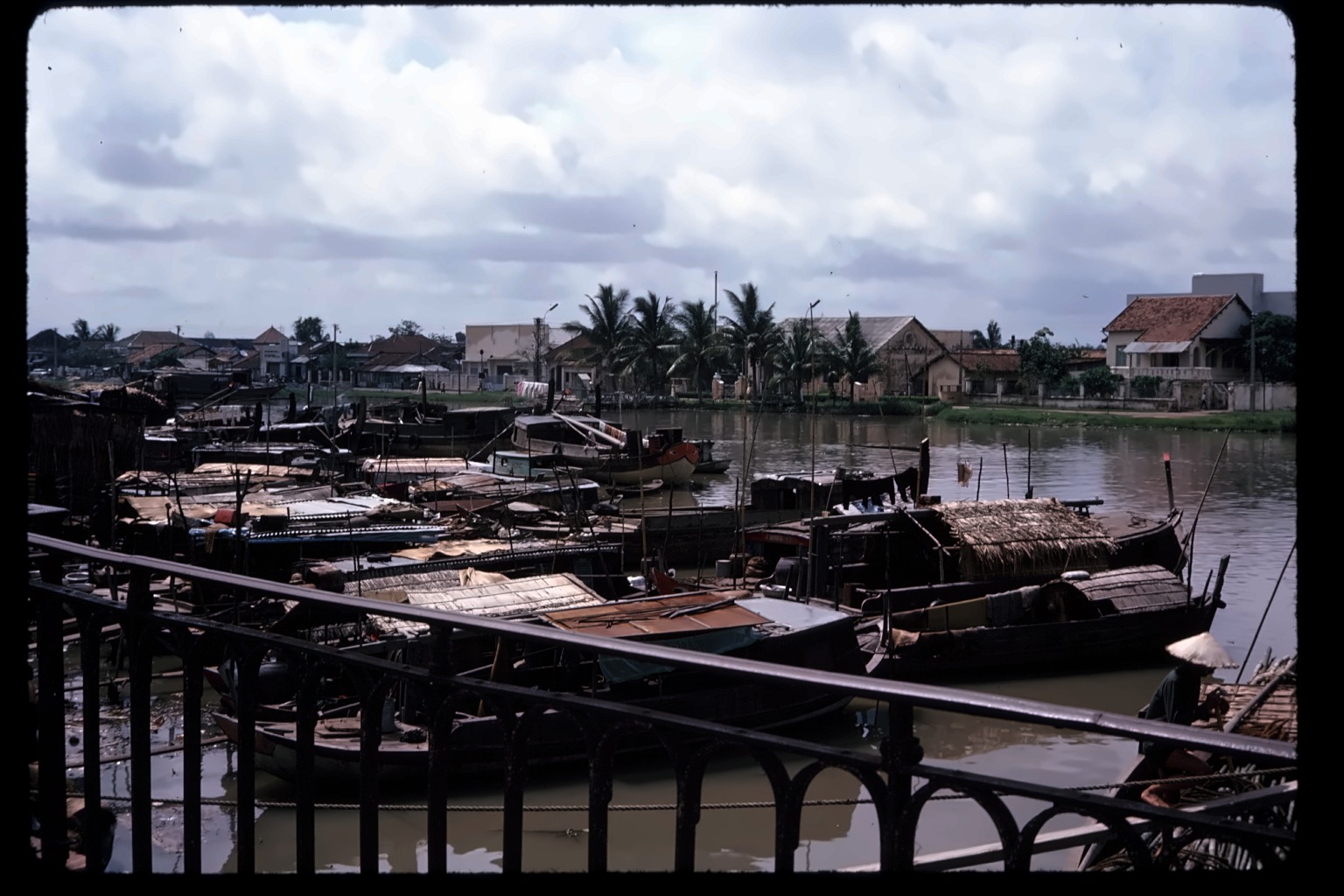
A genuinely dense harbor, dozens of boats packed together across the water, a village of tile-roofed houses and palms on the far bank, shot from a railing over the wharf.
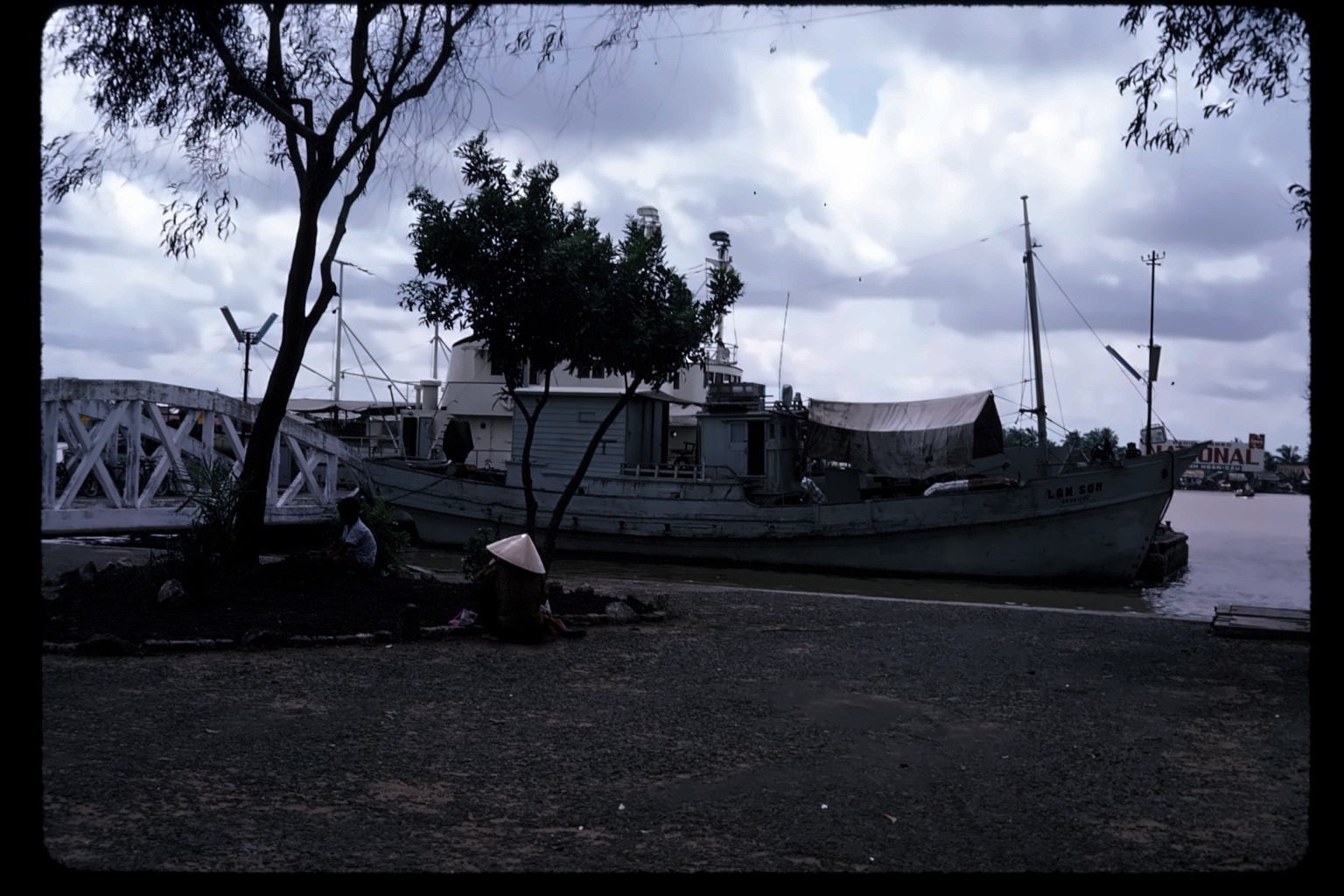
"Hand Shake" reads like his phonetic attempt at "Hàn Giang," the ship's actual name — the same habit seen in "Can Oi" and "Gan Oi" for Khánh Hội elsewhere in the collection, not a literal handshake. This first frame is an establishing shot of the harbor: a civilian coastal vessel named "Lam Sơn" moored at the wharf.
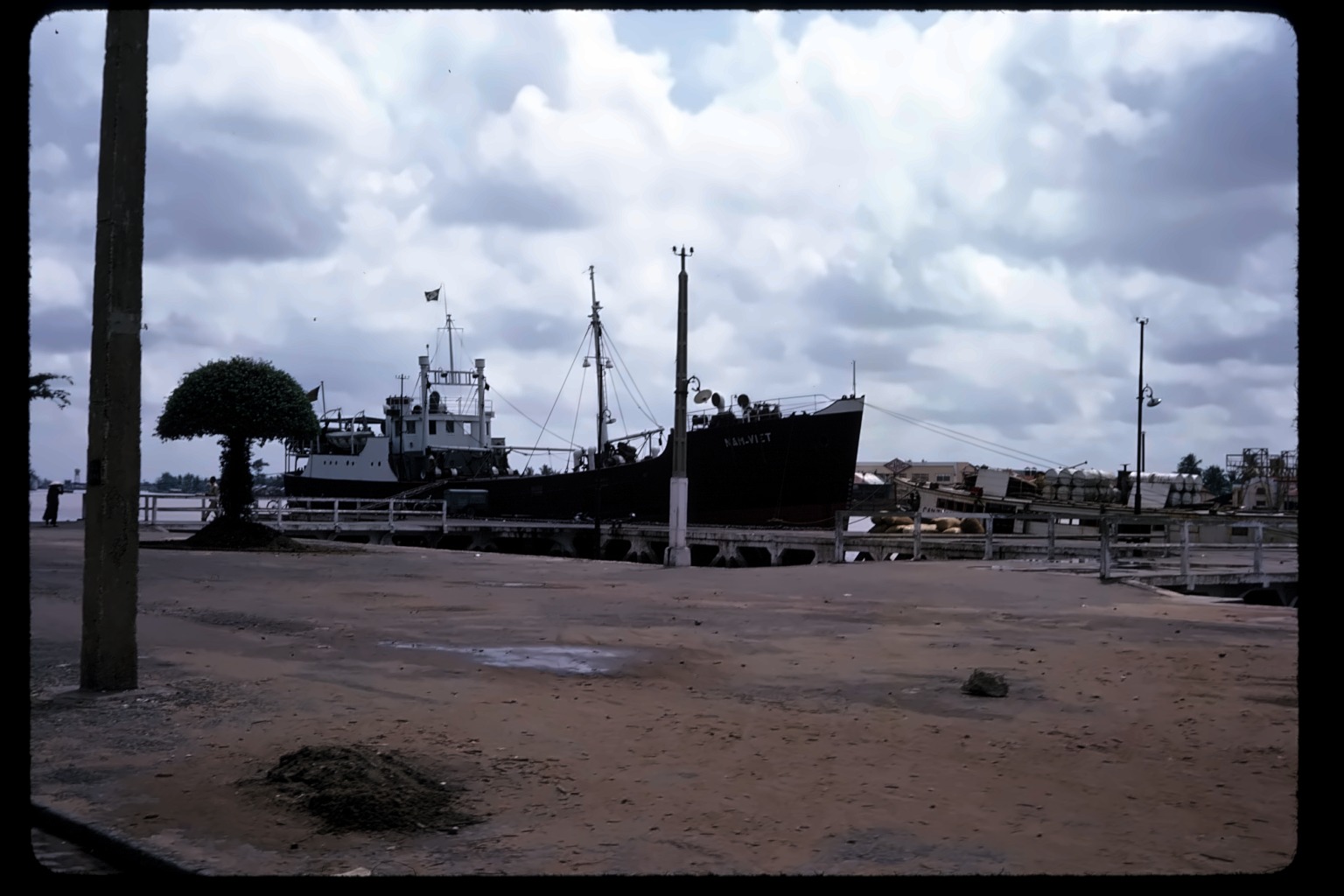
Another vessel at the same dock, a merchant ship named "Nam Việt."
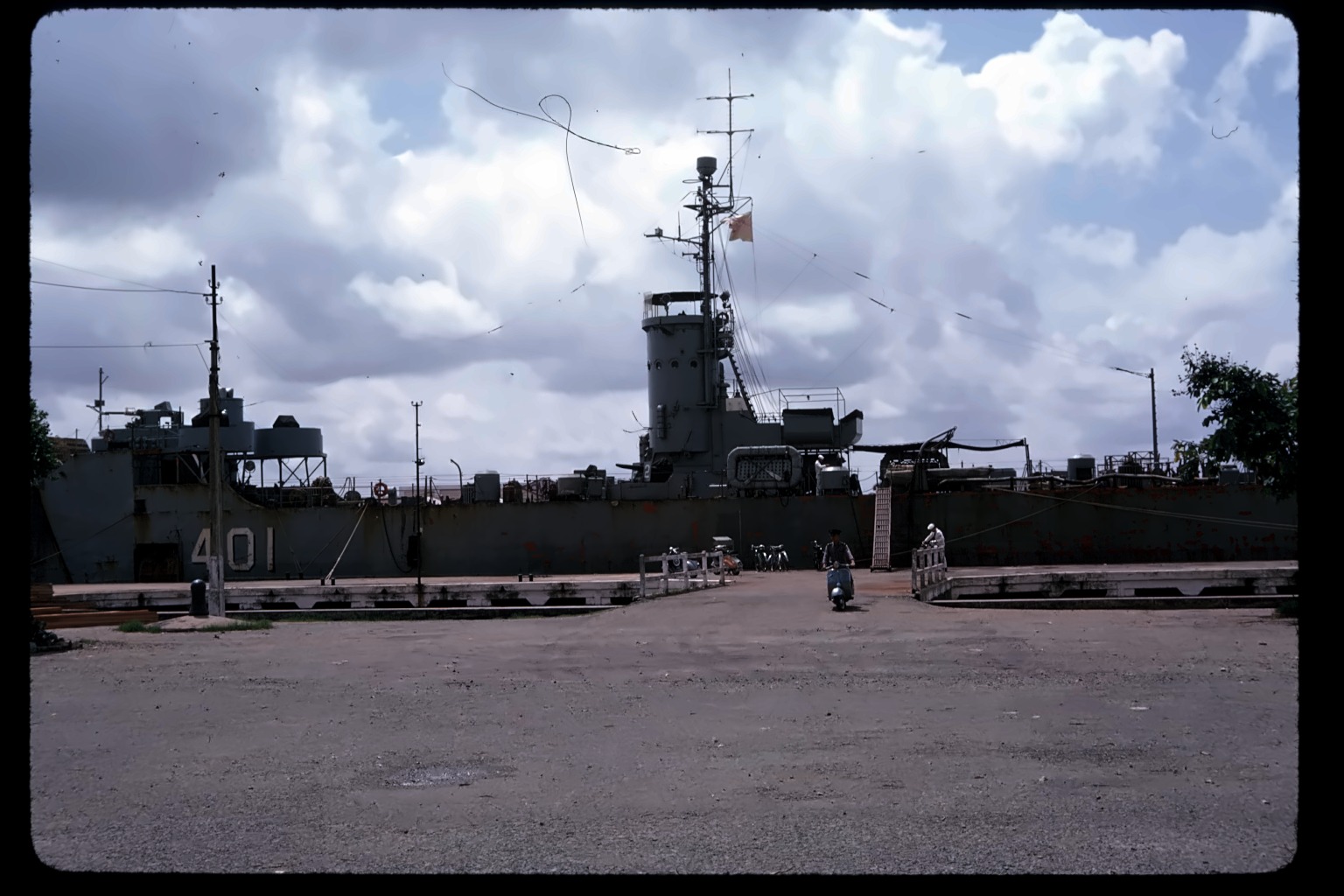
The hull number is fully legible: "401" — RVNS Hàn Giang (HQ-401), a real, documented South Vietnamese Navy ship, a former US LSM landing craft transferred to South Vietnam in 1955 and later used as a hospital ship — a real connection to his own medical role, and almost certainly what "Hand Shake" was standing in for.
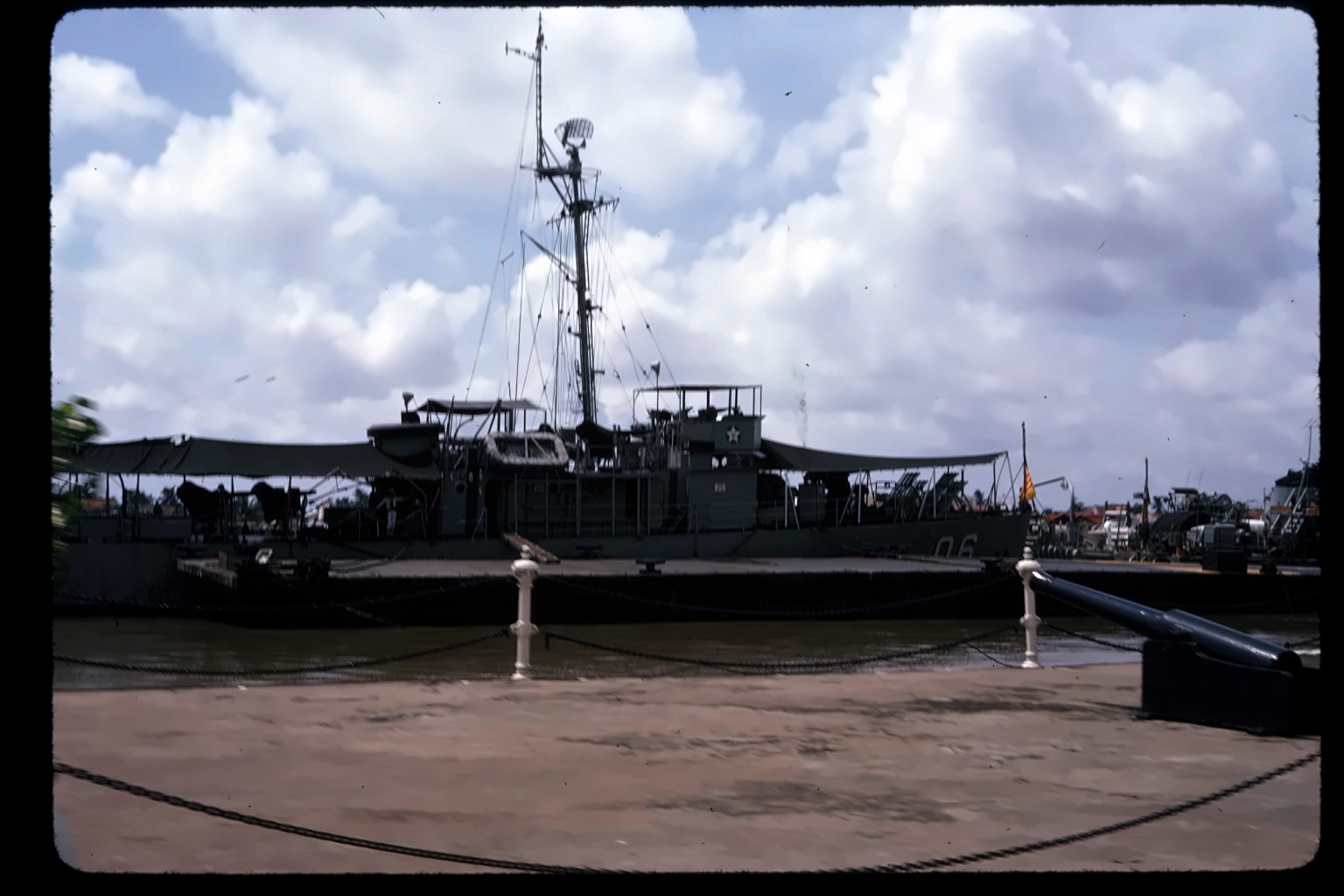
The same ship, RVNS Hàn Giang (HQ-401), a different angle. Closes the sequence.
An unusual small framed image, different in shape from the rest of this tray — from a different roll or camera format, not a window shot. Most of the frame is dark.
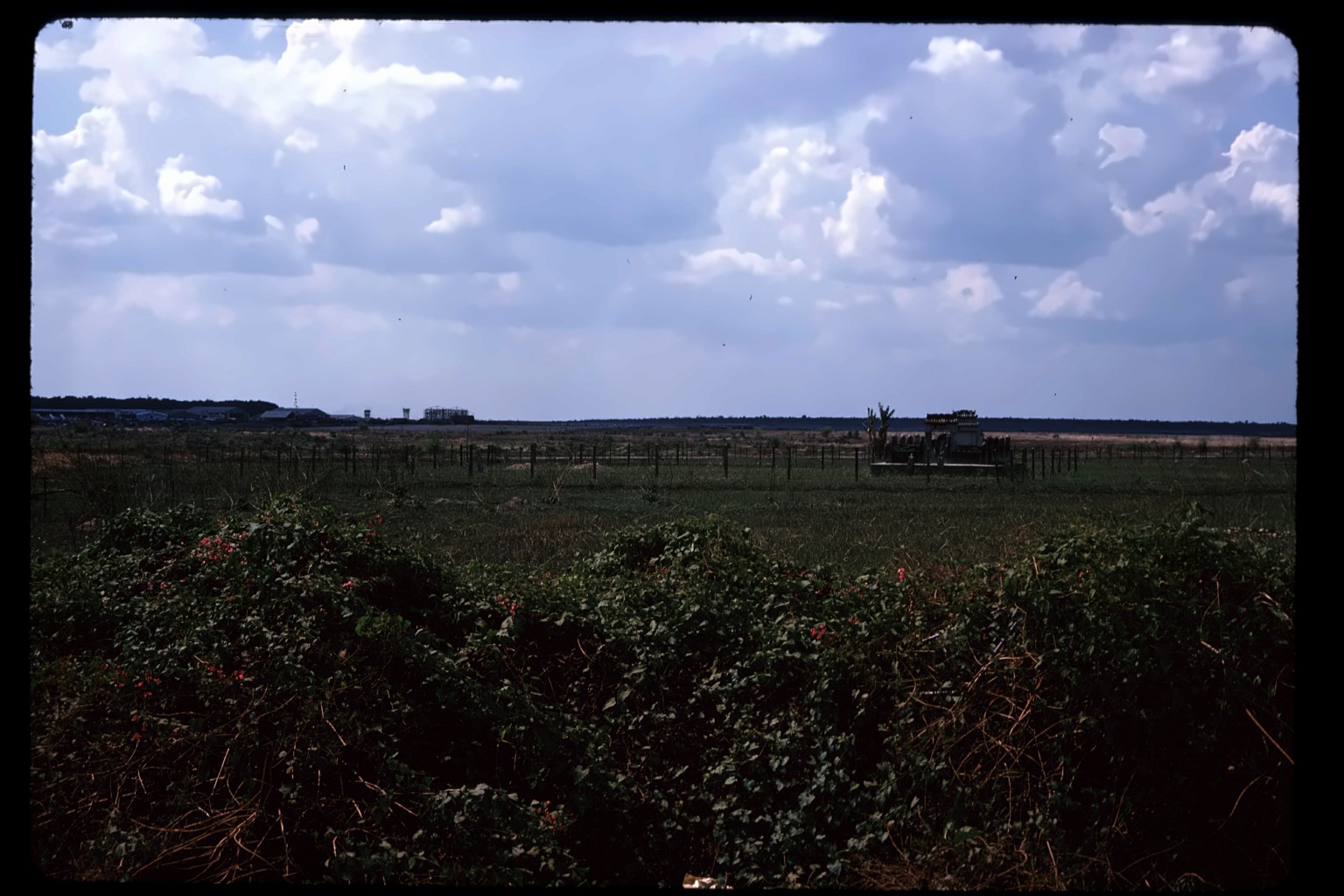
Open fields with an airstrip visible far off — the first sign of Bien Hoa in this reel.
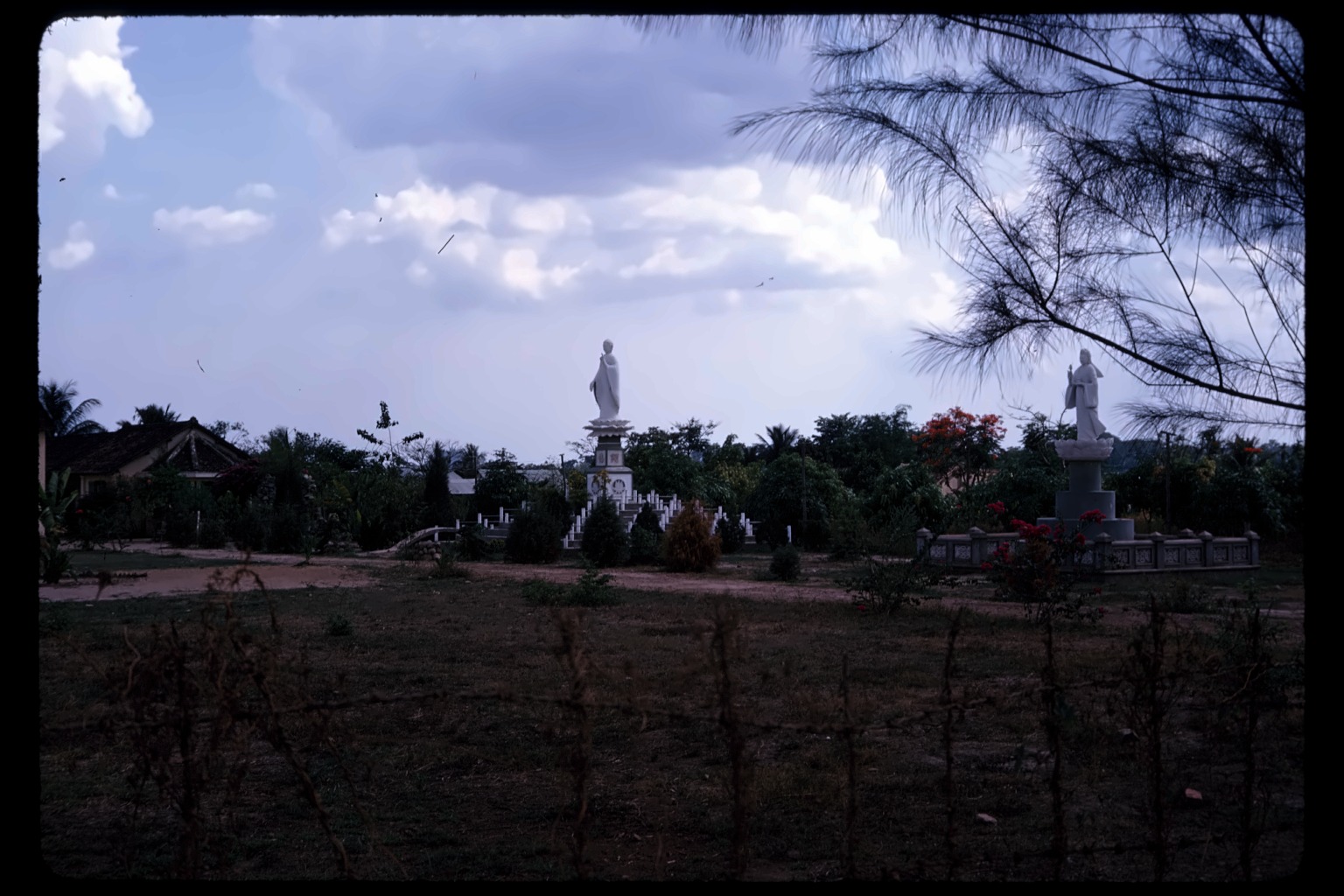
Not the church building itself — religious statuary on the grounds, two figures on pedestals among garden plantings, small white markers behind a low wall that read like Stations of the Cross.
A separate title frame reading "Sai-Gon + Bien Hoa" again — this tray is genuinely two reels merged into one category, continuing where the numbering left off.
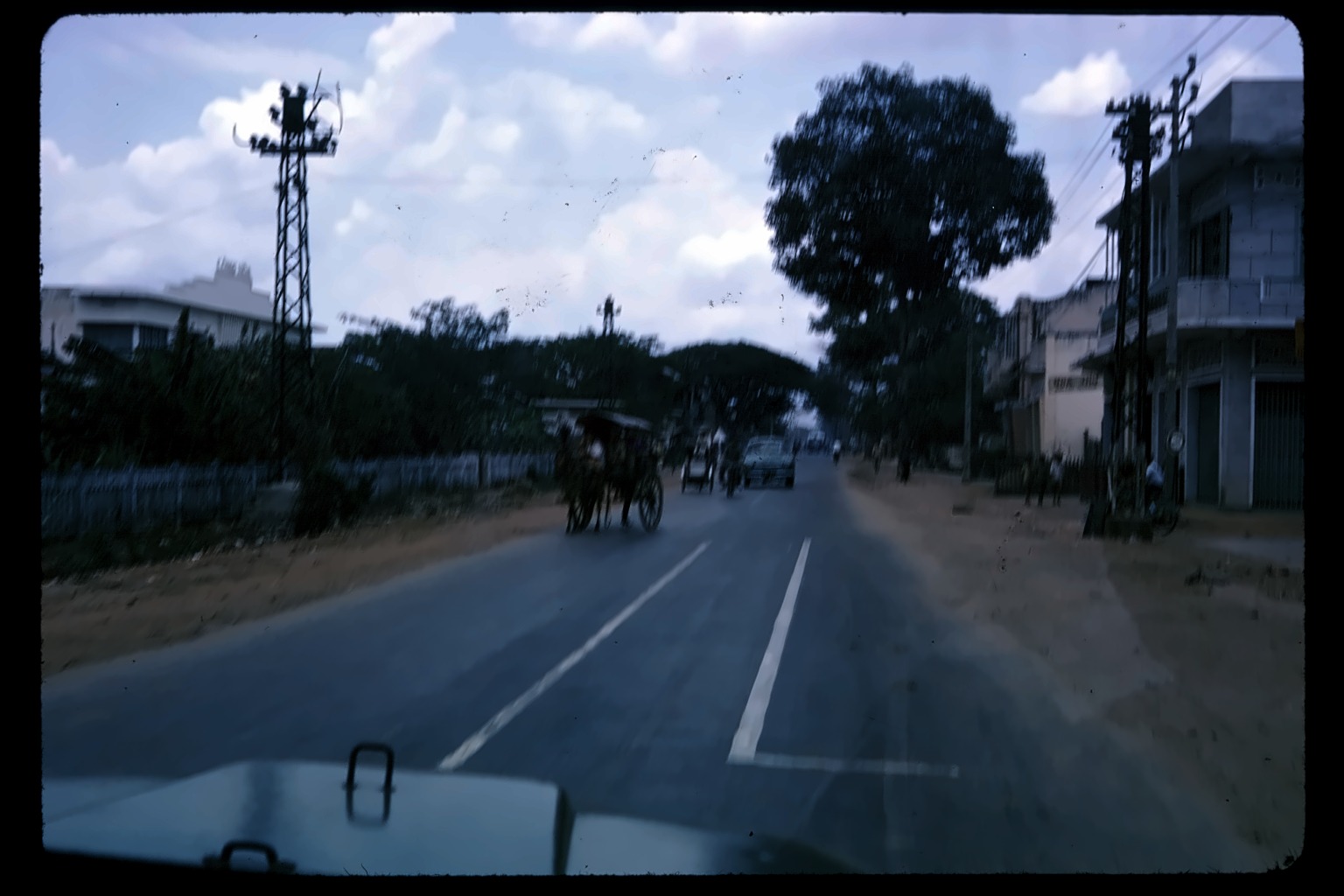
A horse-drawn cart on a road, shot from a moving vehicle.
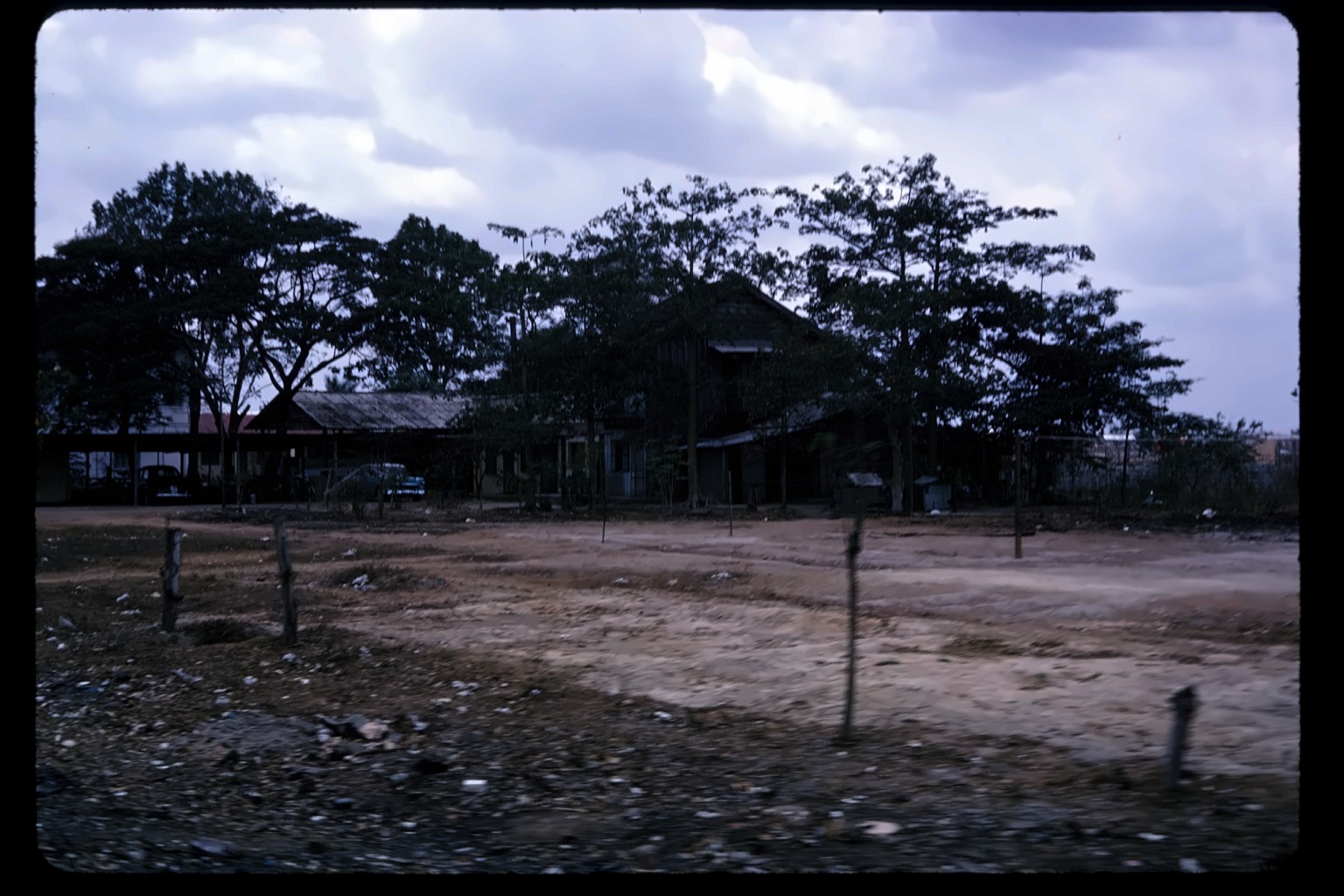
An open, undeveloped lot.
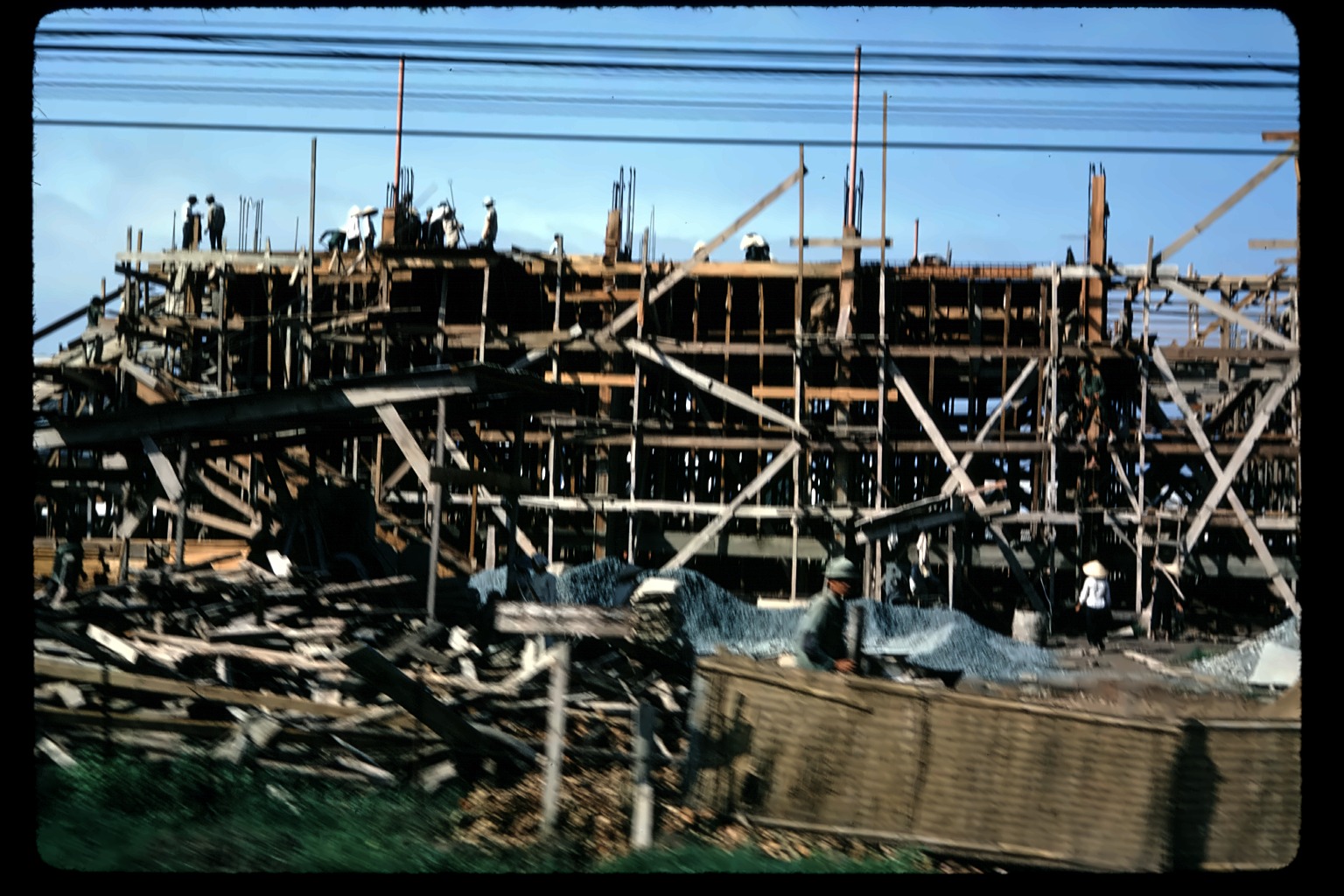
Active construction, workers visible standing on the upper decking — an elaborate lashed wooden scaffold system supporting a multi-story concrete building.
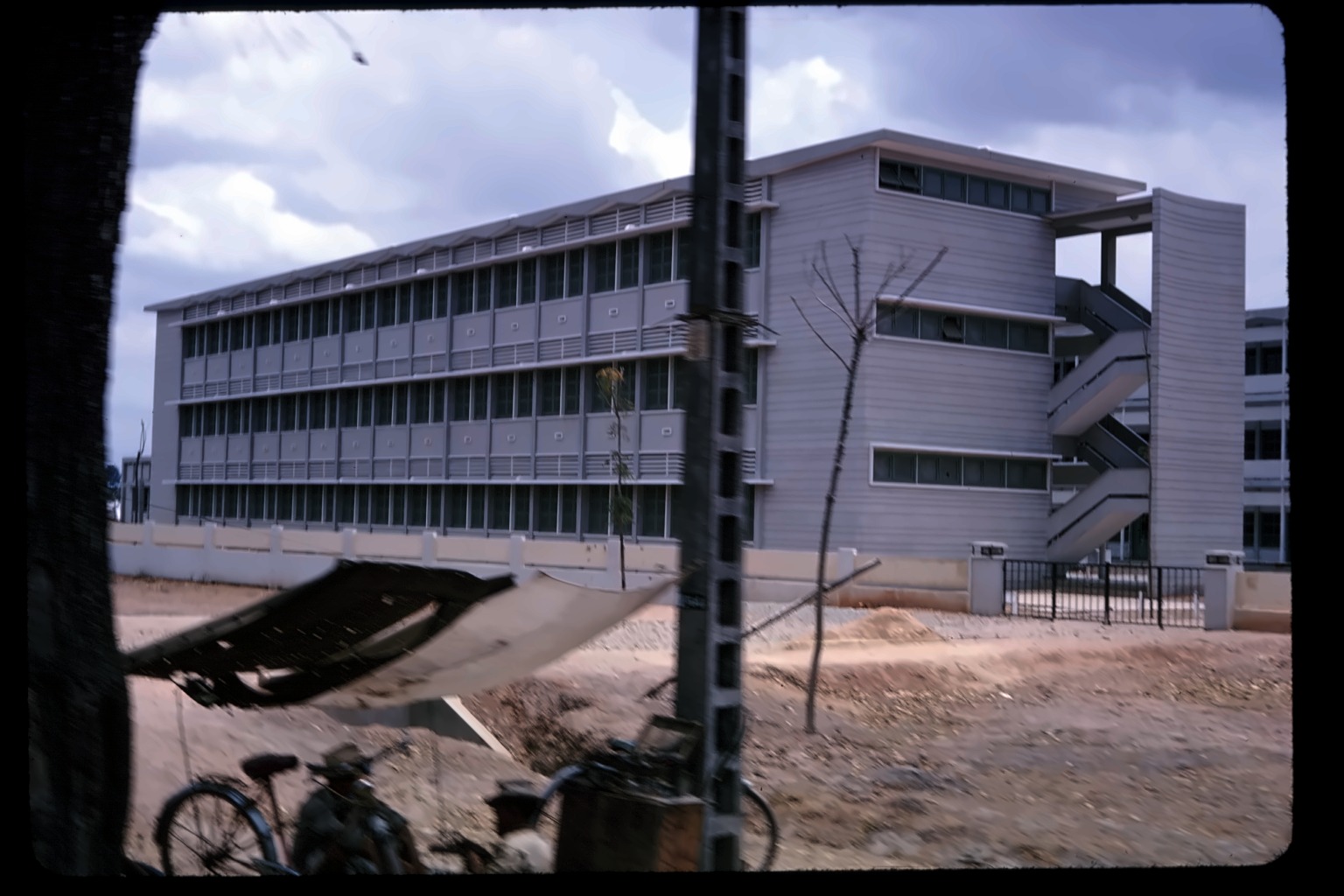
A completed multi-story building — the counterpart to #91's construction shot.
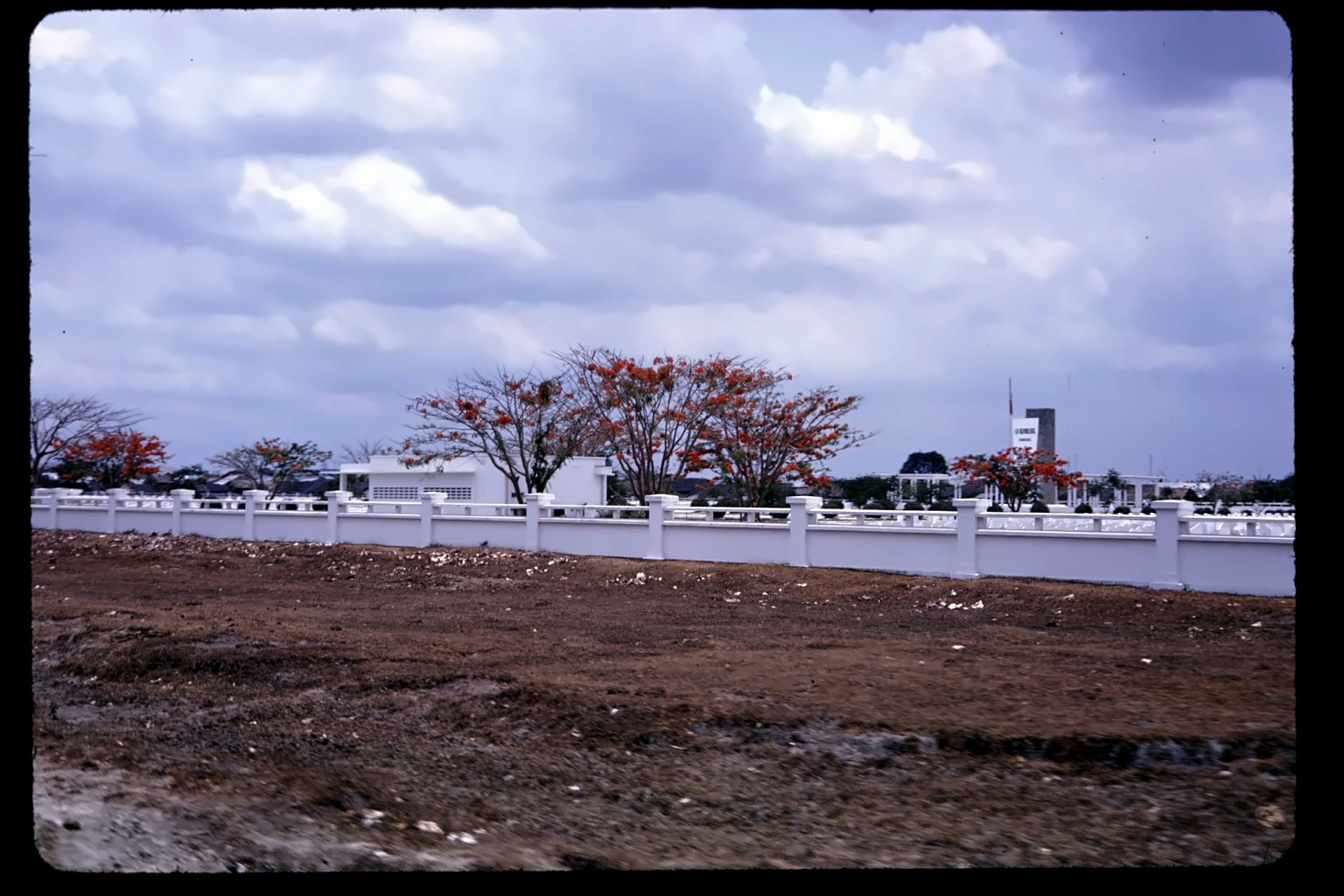
A white balustrade wall marking the cemetery boundary, flame trees in bloom along it, a small tower visible in the distance.
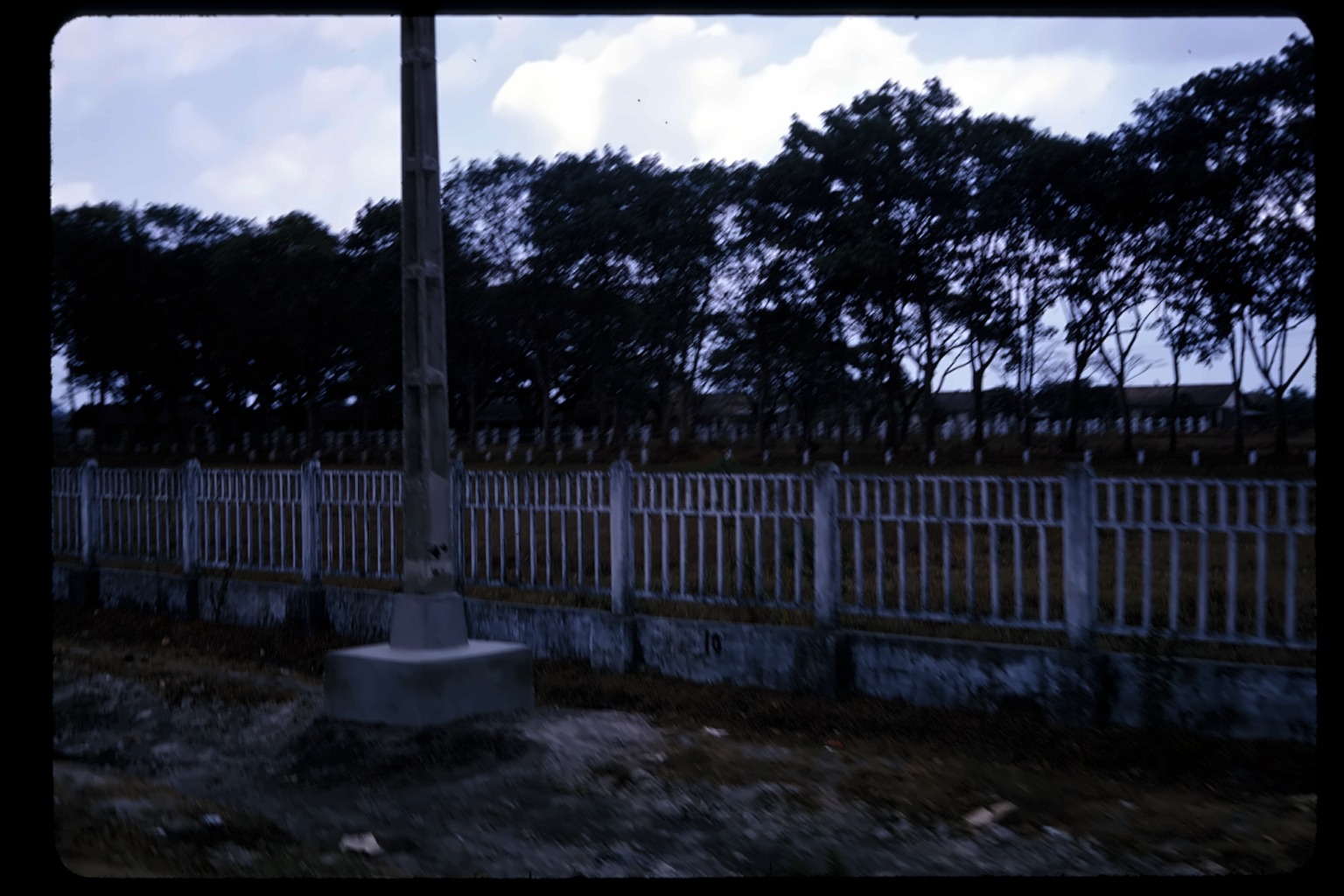
The same cemetery, closer — rows of small white grave markers visible behind the iron fence, extending back toward a tree line.
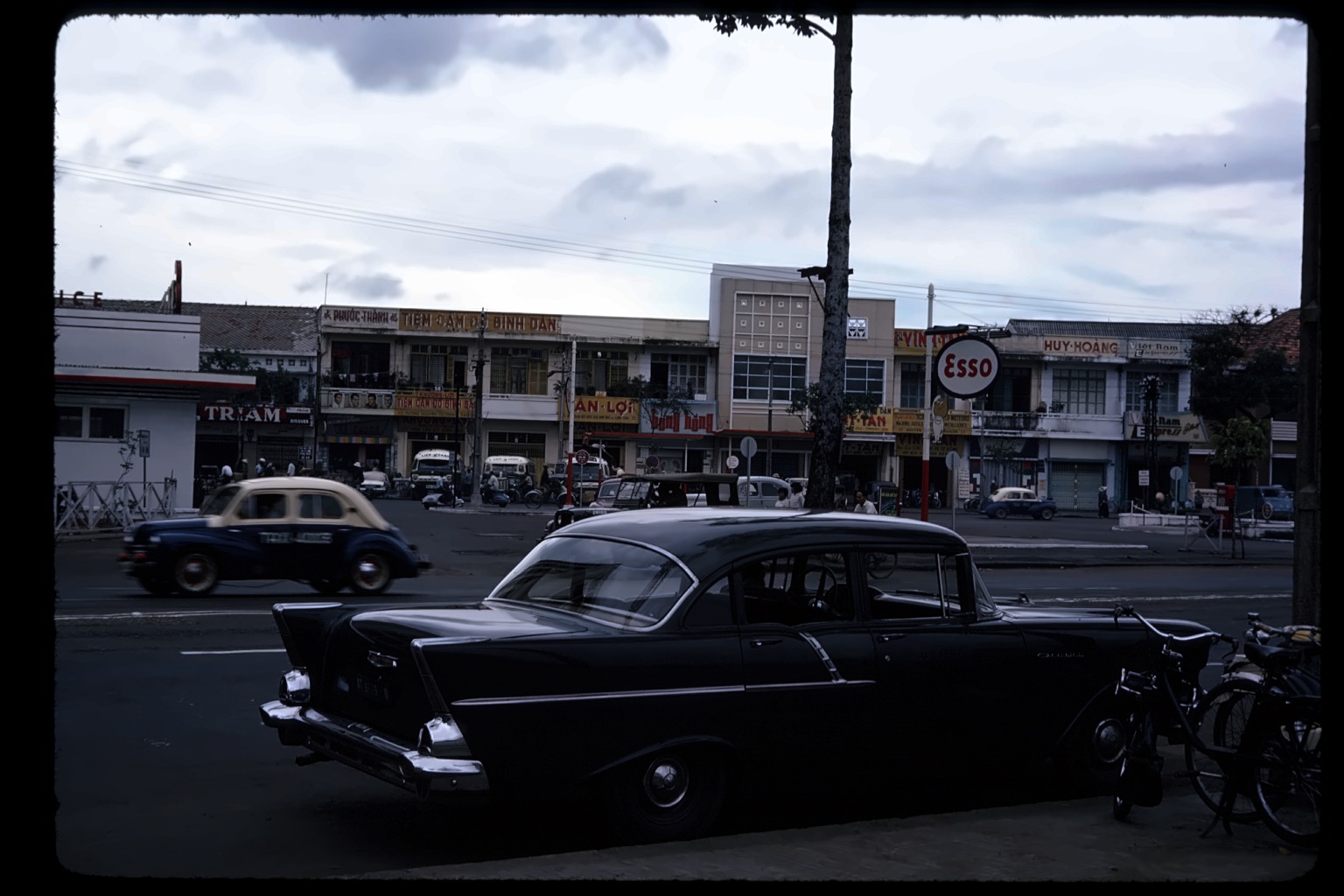
An Esso station, clearly signed. "Cowg Ly" is almost certainly Công Lý ("Justice") Street — a major Saigon street during exactly his tour's era, running past the Independence Palace, renamed Nam Kỳ Khởi Nghĩa after 1975.
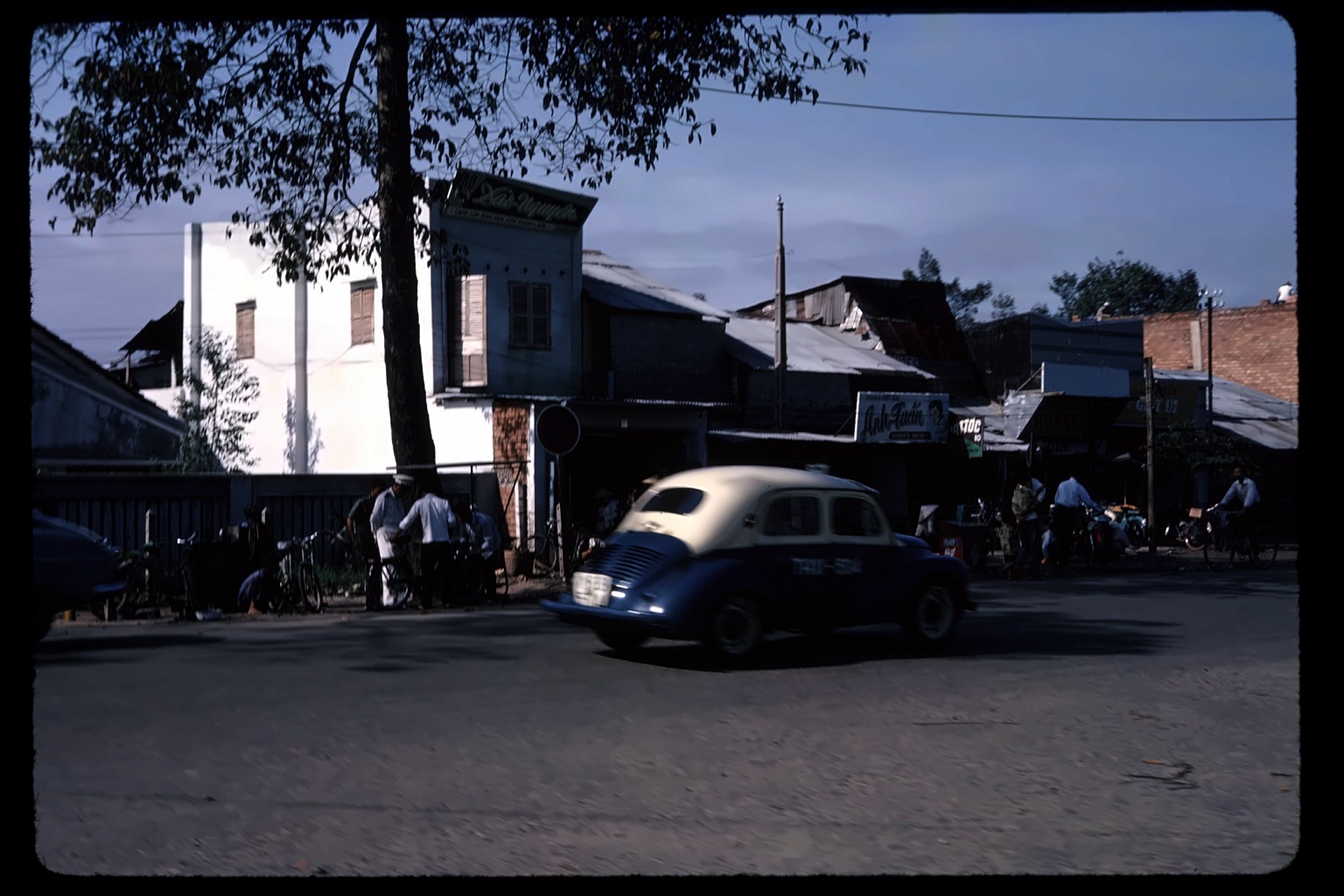
A taxi marked "Sài Gòn" on the door, in motion through a street lined with named shops and workshops.
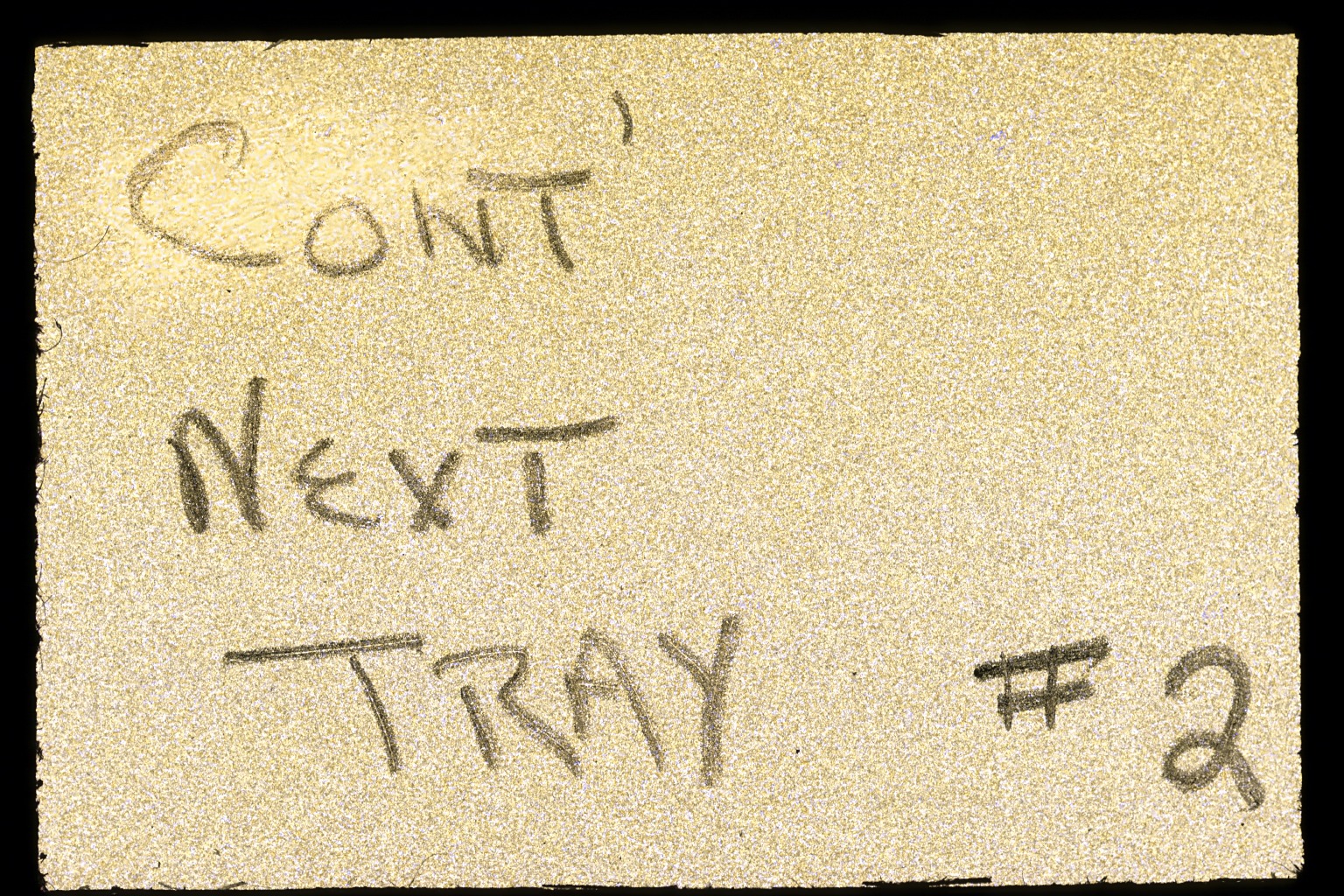
His own note marking the transition to the next tray — the same phrase that appears at slide 100 in other trays, confirming these were physically sequential carousels.